
AI-enabled Mentoring for Stronger Edu-leaders and Resilient Communities
Case at a Glance
Impact
50%
increase in mentoring coverage

17%
reduction in per-fellow mentoring cost

30%
boost in buddy efficiency
About the organisation
With a vision to ensure Voice and Choice for Every Woman, I-Saksham empowers young women in Bihar’s villages to become community change-leaders. Through a two-year immersive leadership program and ongoing alumni engagement, participants:
- Build self-belief, confidence, and aspiration.
- Lead by strengthening children’s and adolescent girls’ life skills while engaging parents to create a supportive ecosystem.
- Form peer clusters to deliberate and act on personal and community challenges.
- Pursue aspirations by linking with academia, government, and civil society, becoming local role models.
- Earn family and community acceptance, reshaping perceptions of women’s roles.
Problem Statement
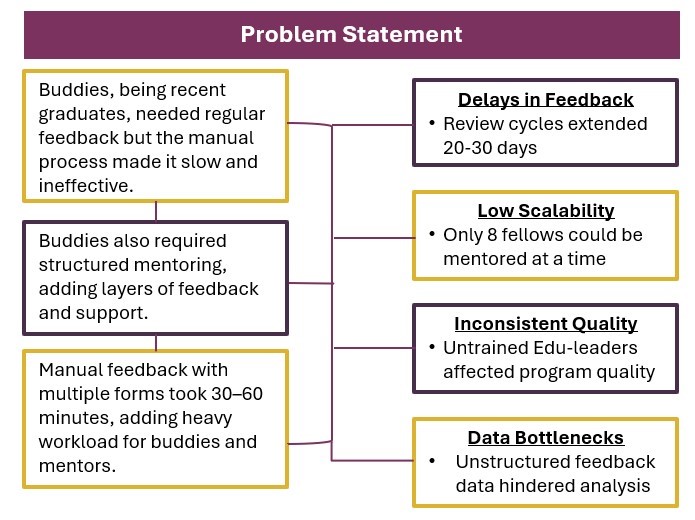
I-Saksham faced significant bottlenecks in its peer coaching ‘Buddy Talk’ process, essential for edu-leader development. Manual, time-intensive feedback led to delays (20-30 days), low buddy-to-fellow ratios (1:8), inconsistent coaching quality, and unstructured data, hindering efficient scaling of their human-centred mentoring model.
Solution
I-Saksham implemented an AI-assisted mentoring solution to streamline the ‘Buddy Talk’ process. This involved leveraging technology to automate and accelerate feedback, reducing operational burden while maintaining a human-centred approach. The solution was rolled out using a phased, user-driven strategy, engaging field teams as co-designers to ensure effective adoption.
Quick Facts

Organisation Name
I-Saksham

Organisation Website
Visit Site

Founding Year
2015

Number of Beneficiaries served
600+ fellows trained, impacting over 12,000 children and 10,000 parents

Geography Served
Rural Bihar

Focus Area
Programmatic Impact, Operational Efficiency, Capacity Building
Functions Impacted
Program Delivery, Training and Capacity Building

SDG Addressed



Full Case Study
Challenge
Manual, layered feedback slowed mentoring, drained time, and limited the program’s ability to scale
The participants of the Fellowship are known as Edu-Leaders. Every edu-leader is assigned a coach known as a buddy and the peer coaching conversations are key to the development of the edu-leader. Building capacity of buddies to conduct effective coaching is also critical as they are recent graduates from the fellowship.
As the Fellowship scaled, I-Saksham faced a key bottleneck in its Buddy Talk process—the peer coaching conversations between edu-leaders and their assigned buddies. Since buddies were recent graduates, they too needed structured support, creating a dual mentoring requirement.
The manual, two-step feedback process was time intensive. Buddies submitted detailed forms after each session, which were reviewed by mentors who added their own feedback. Each cycle took 30 to 60 minutes, placing a heavy documentation burden on both roles.
This led to delayed feedback (20–30 days), low buddy-to-fellow ratios (1:8), inconsistent coaching quality, and unstructured data that was difficult to analyse. I-Saksham needed a solution that would reduce this operational load without compromising its human-centred mentoring model.

Solution
Lean, field-tested AI simplified mentoring by automating transcription, feedback, and actionable insights.
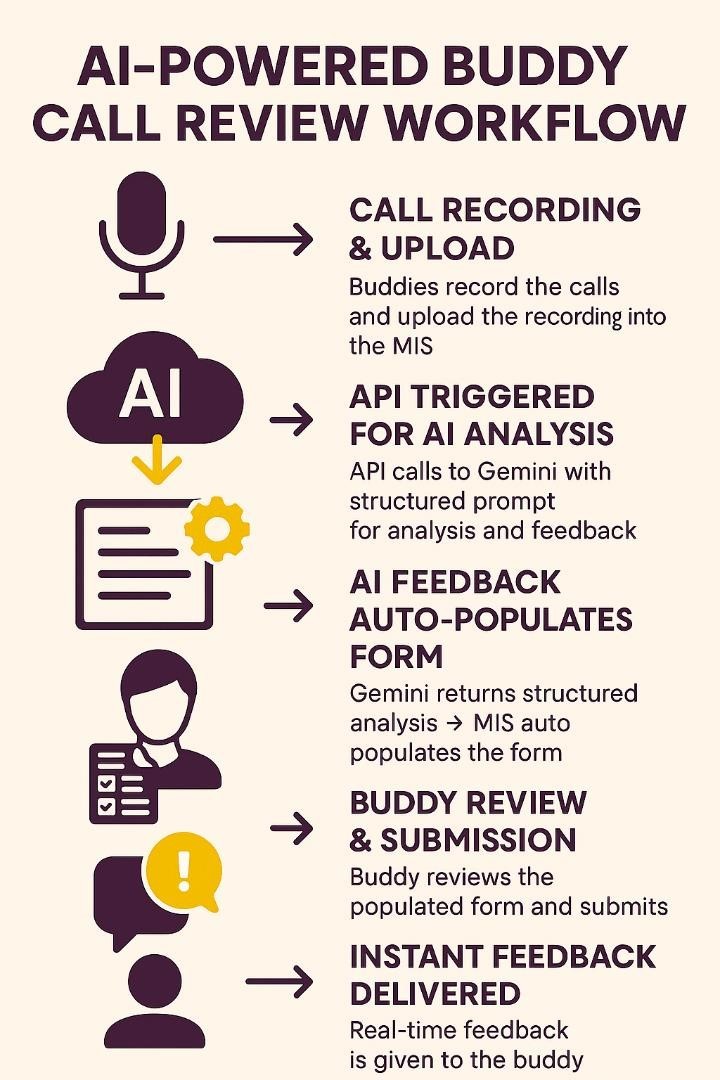
Rather than investing in heavy tech, I-Saksham chose lean, field-informed AI to solve a real pain point. Using models like Whisper and Gemini, they built a lightweight system that transcribed Buddy Talk calls, identified speakers, and auto-summarised insights.
Feedback forms were filled automatically, and just-in-time coaching notes were generated using LLM-powered prompts. Every element of this pipeline was tested with end users, ensuring that AI amplified and not disrupted the program.
The rollout followed a phased, user-driven approach. Starting with pilot cohorts, the tech was tested, adapted, and integrated into existing workflows. Field teams were treated as co-designers, not end users fostering trust and ensuring adoption.
A lean, 7-member tech/data team supported implementation, and monthly review cycles maintained strategic alignment. The focus wasn’t on replacing human processes but making them faster, lighter, and more consistent.
Outcomes & Impact
Smarter processes led to broader reach, lower costs, and higher-quality coaching across the fellowship.
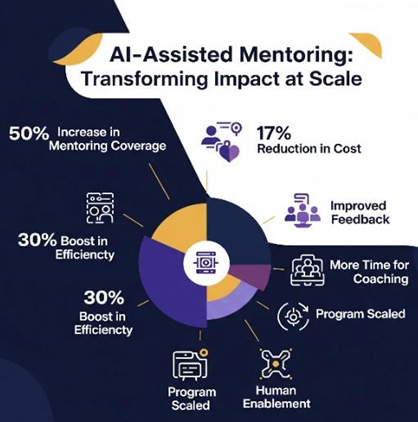
The shift to AI-assisted mentoring produced outsized results:
- 50% increase in mentoring coverage
- 17% reduction in per-fellow mentoring cost
- 30% boost in buddy efficiency
- Significant improvement in feedback quality and timeliness
- Staff time freed for coaching and strategic focus
- Program scaled without compromising its core values
- Not just digital transformation but human enablement at scale
Technology Stack
| Name of the Tool | Where it was used | What it enabled | Category |
|---|---|---|---|
| Whisper | Buddy Talk call recordings | Automated audio transcription into text | Open-source |
| Gemini 1.5 | Transcribed Buddy Talk data | Summarisation and generation of coaching feedback | Commercial |
| Azure & AWS Credits | Backend infrastructure | Cloud hosting, storage, and compute resources | Commercial |
| WhatsApp Chatbot | Program operations & field team adoption | User adoption | Custom-built |
| Zoom | Remote mentoring & communication | Virtual Buddy Talks and training sessions | Commercial |
Key Project Learnings
- Design for adoption, not just function: co-create with users, iterate fast, and keep solutions simple.
- Use AI as a co-pilot: let technology ease routine work so people can focus on deeper, human impact.
- Start small, scale smart: intentional, context-rooted innovations can unlock large system shifts.
Potential for Wider Adaption
| Sector | Adaptability of the Solution |
|---|---|
| Education | Fellowship and mentoring programs can use AI to automate feedback, save time, and scale reach. |
| Healthcare | Community health programs can streamline reporting and enable timely supervision of workers. |
| CSR | Corporate initiatives can reduce manual tracking and improve monitoring of trainers/volunteers. |
| Beneficiary Support | Call-based services can use AI to transcribe, summarise, and convert conversations into actionable insights. |
The information provided here is created as a community resource and is not intended as professional advice or a recommendation by ILSS or Koita Foundation. While we strive to ensure the accuracy of the content, we do not take responsibility for any errors or omissions. Users should use their own discretion before making any decisions based on this information. ILSS or Koita Foundation assume no liability for any actions taken based on the information provided.