
Adalat AI: AI-Enabled Courtroom Operations Accelerating Justice Delivery
Strengthening Judicial Capacity through Real-Time Transcription and Workflow Automation

Watch the story in 60 seconds (AI-generated video; visuals are illustrative)
Case at a Glance
Adalat AI is a non-profit justice-tech organisation building an end-to-end AI platform for courts in India and the Global South. Working directly with High Courts and District Courts, Adalat AI modernises core courtroom workflows (transcription, documentation, case-flow management, and evidence handling) to make justice delivery more timely, efficient, and accessible.
India’s judiciary faces over 50 million pending cases, with an average case taking nearly 13 years to conclude. Despite sustained effort by judges and court staff, manual documentation processes and chronic shortages of stenographers create severe bottlenecks. Courts spend disproportionate time on routine tasks such as dictation, order writing, and evidence summarisation, limiting judicial capacity for adjudication.
Adalat AI built an AI-powered courtroom operating system that enables real-time transcription, automated documentation, and streamlined case-flow management within courtrooms. Optimised for Indian legal language and multilingual proceedings, the platform reduces manual workload for judges and court staff, accelerates hearings, and strengthens the efficiency of justice delivery.
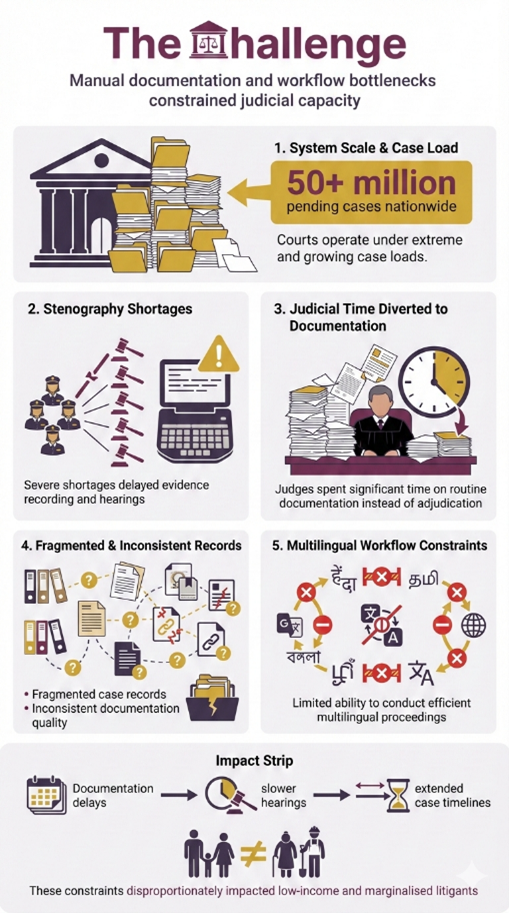
India’s courts operate under extreme case loads, with over 50 million pending cases nationwide. A critical constraint is manual documentation particularly live transcription and order drafting which relies heavily on a limited pool of stenographers.
Key challenges included:
These constraints slowed hearings, extended case timelines, and disproportionately impacted litigants from low-income and marginalised communities.
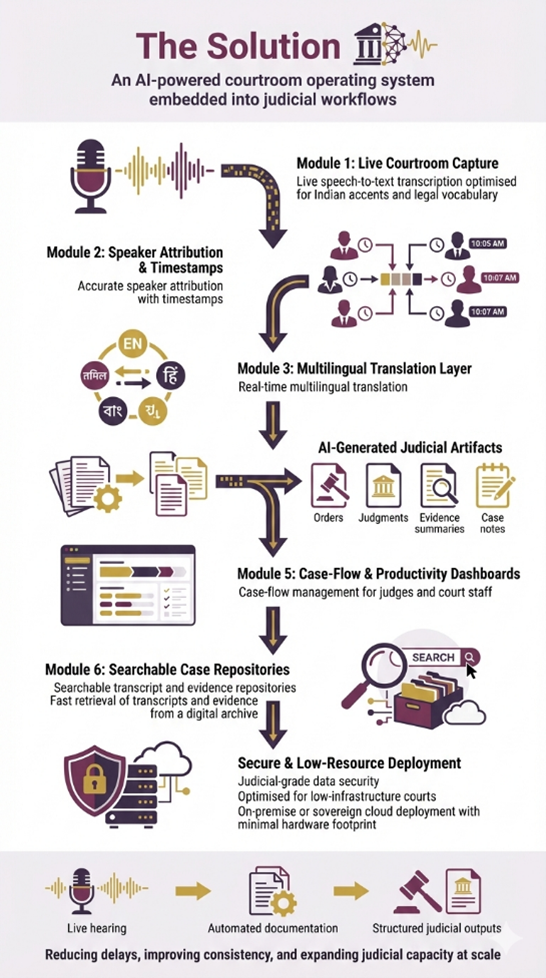
Adalat AI built a comprehensive courtroom Operating System anchored around live, high-accuracy speech-to-text transcription optimised for Indian accents, dialects, and legal vocabulary. The platform integrates natural language processing and custom legal large language models to automate core courtroom workflows.
Key features of the solution include:
- Live courtroom transcription with speaker attribution and timestamps
- Multilingual translation between English and major Indian languages
- AI-generated orders, judgments, evidence summaries, and case notes
- Case-flow management dashboards for judges and court staff
- Searchable transcript and evidence repositories
- Secure on-premise or sovereign cloud deployment meeting judicial data standards
- Low-resource optimisation for courts with minimal hardware infrastructure
Technology Stack
| Tools/ Techniques | Used For | What It Enabled | Category |
|---|---|---|---|
| Automatic Speech Recognition (ASR) | Live hearings | Real-time transcription of legal proceedings | Custom-built |
| Natural Language Processing (NLP) | Documentation workflows | Summarisation, entity tagging, and exhibit mapping | Custom-built |
| Custom Legal LLMs | Orders and judgments | Drafting and automation using privacy-preserving legal models | Custom-built |
| Machine Translation Models | Multilingual courts | Translation across major Indian languages | Custom-built |
| Secure Web Platform | Courtrooms | Role-based access to transcripts and dashboards | Custom-built |
| Azure Cloud & On-Prem Deployment | Judicial infrastructure | Secure, scalable hosting compliant with data standards | Commercial |
Key Project Learnings
Reducing time spent on routine documentation enabled judges to focus more on adjudication, accelerating hearings and case disposal.
Deploying AI directly inside courtrooms, rather than as a peripheral tool, supported sustained use by judges and staff.
Privacy-preserving models and sovereign deployment options were essential for institutional acceptance in the justice system.
Potential for Wider Adaptation
| Sector | Adaptability of the Solution |
| Judicial Systems | Applicable across district and high courts facing case backlogs |
| Global South Courts | Relevant for multilingual, resource-constrained justice systems |
| Quasi-Judicial Bodies | Adaptable for tribunals, commissions, and administrative courts |