
Vowels of the People Association (VOPA): AI & Evidence-based FLN Assessments
Strengthening Foundational Literacy and Numeracy through Accurate, Scalable Assessments


Watch the story in 60 seconds (AI-generated video; visuals are illustrative)
Case at a Glance
Vowels of the People Association (VOPA) builds technology-led, scalable solutions in education and mental health to nurture responsible and empowered citizens. Its flagship initiatives include statewide FLN assessment systems, free digital learning ecosystems, and culturally relevant mental health platforms for underserved communities.
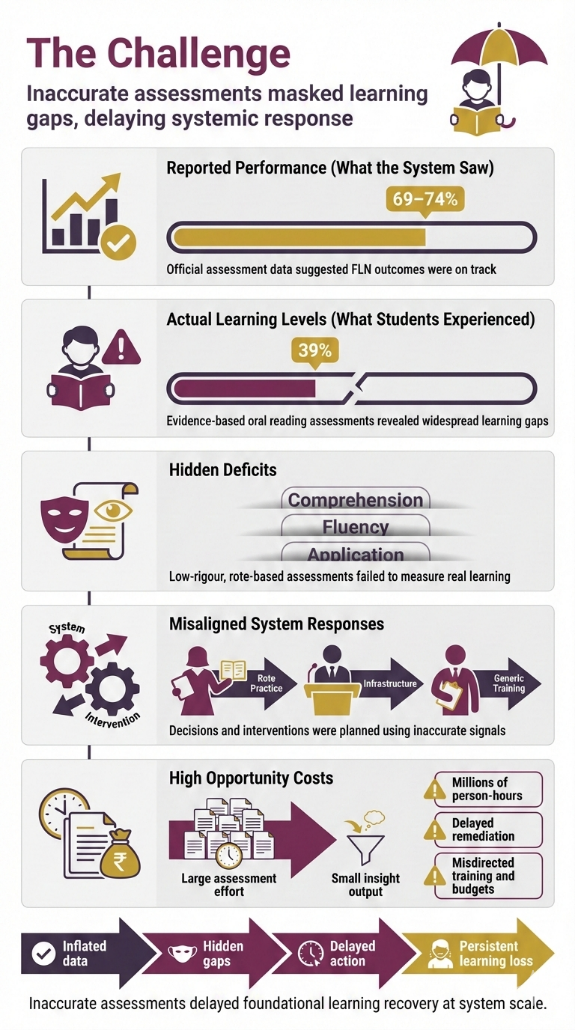
Official FLN assessment data in Maharashtra indicated reading proficiency levels of 69–74%. However, evidence-backed assessments revealed actual proficiency below 40%, with nearly 60% of early-grade children struggling with basic reading and numeracy. Existing assessment practices relied on superficial or rote-based evaluations, creating false visibility, delaying interventions, and leading to misinformed policy and resource allocation decisions.
VOPA developed an AI-powered FLN assessment system through the ‘NIPUN Maharashtra’ app to deliver accurate, joyful, and scalable oral reading and numeracy assessments. The solution enables real-time, evidence-led evaluation of student learning using speech recognition, adaptive assessment flows, and automated reporting. Teachers, supervisors, and administrators receive actionable insights through role-specific dashboards, while parents can track assessment evidence and access personalized remedial tools.
Foundational Literacy and Numeracy (FLN) assessments are critical for guiding early learning interventions and policy decisions. However, in Maharashtra, existing assessment practices created a misleading picture of progress:
VOPA’s AI-powered ‘NIPUN Maharashtra’ app was designed to generate reliable, real-time evidence on FLN outcomes at scale. The solution uses refined open-source Marathi Indic AI models for Automatic Speech Recognition (ASR) to assess oral reading fluency across alphabets, words, sentences, and passages.
Key features of the solution include:
- AI-driven oral reading and numeracy assessments using speech recognition.
- Evidence-led, adaptive assessment flows across alphabets, words, sentences, and passages.
- Real-time audio streaming with noise detection and chunking for low-bandwidth classrooms.
- Automated assessment reports capturing words per minute, accuracy, and error patterns.
- Role-based dashboards for teachers, headmasters, supervisors, and administrators.
- Integration with government systems such as UDISE+, SARAL, and SHALARTH.
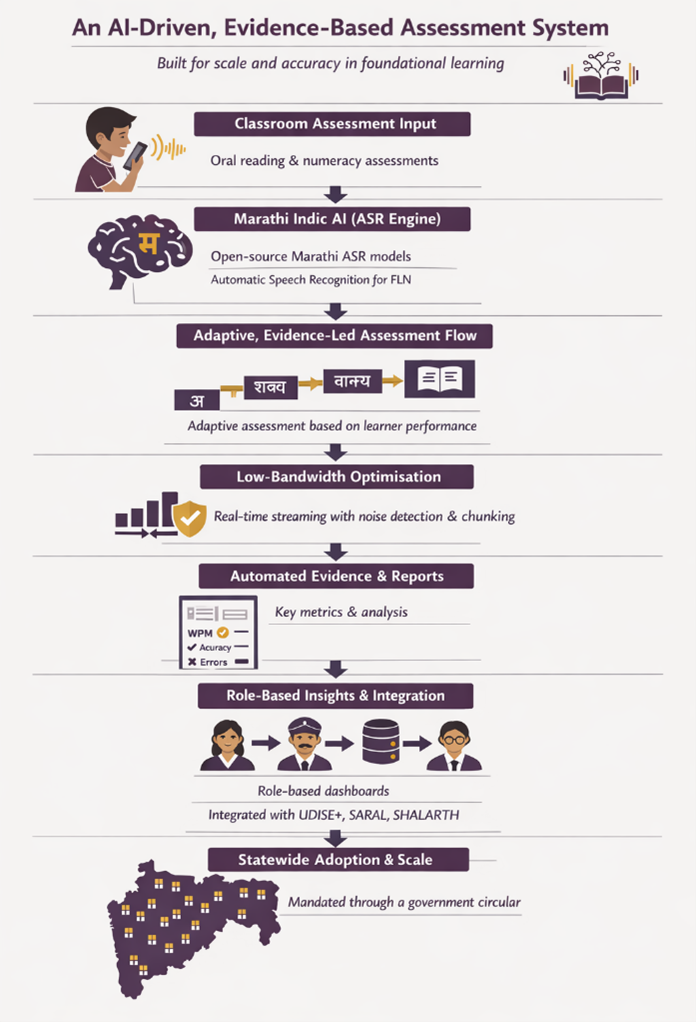
Rolled out through a government circular, the project was made mandatory for all schools, enabling rapid statewide adoption.
Technology Stack
| Tools/ Techniques | Used For | What It Enabled | Category |
|---|---|---|---|
| Marathi Indic ASR Models | Oral reading assessments | Speech-to-text evaluation for FLN | Open Source |
| FastAPI (Python) | Backend framework | Scalable API-driven architecture | Open Source |
| MongoDB | Data storage | Secure storage of assessment data | Open Source |
| Redis | Caching layer | Low-latency performance at scale | Open Source |
| Noise Detection Library | Audio processing | Reliable assessment in noisy classrooms | Open Source |
| WebSockets with Audio Chunking | Live assessments | Real-time, low-bandwidth audio streaming | Open Source |
Key Project Learnings
VOPA’s implementation demonstrates how evidence-led AI can drive large-scale course correction in education systems:
Replacing inflated, self-reported assessments with AI-backed evidence revealed the true extent of FLN gaps. This visibility enabled the state to reset priorities toward foundational learning and redirect training, monitoring, and budgets at scale.
Simple, joyful, and low-friction assessment flows allowed teachers and supervisors to adopt the system quickly. This ease of use supported statewide rollout, large supervisor mobilisation, and assessment coverage far beyond initial targets.
Granular, role-based dashboards linked learning outcomes to action at every level. This improved follow-through, enabled targeted interventions by grade and geography, and strengthened accountability across the education system.
Potential for Wider Adoption
| Sector | Adaptability of the Solution |
| State Education Systems | Applicable for large-scale FLN assessments across diverse linguistic and geographic contexts |
| National Education Programs | Relevant for evidence-based monitoring of foundational learning outcomes |
See it in Action
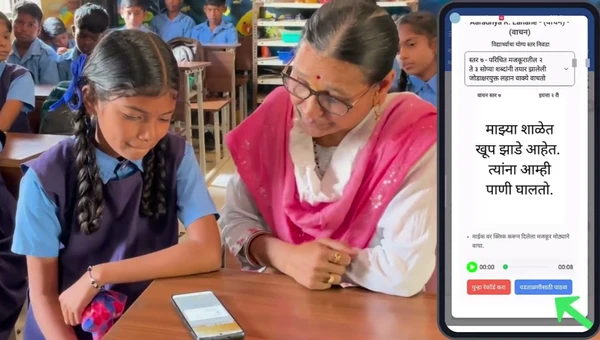
The Nipun Maharashtra app uses AI to assess reading via voice recordings, instantly generating reports on speed, accuracy, levels, and errors for students, teachers, and parents.

An education official describes how the Nippon Maharashtra app brought measurable learning outcomes to 33 ashram schools

VOPA is a not-for-profit initiative in education field. We provide teacher training and school transformation assistance to schools. We provide a free e-learning platform - VSchool to all students in Maharashtra.