
Educate Girls: Predictive Targeting to Enroll Girls
How Educate Girls leveraged machine learning with public datasets to enable predictive targeting of high-need villages, accelerating enrollment of out-of-school girls at scale.




Watch the story in 60 seconds (AI-generated video; visuals are illustrative)
Case at a Glance
Educate Girls is a non-profit working in India’s rural and educationally backward districts to improve girls’ enrollment, retention, and learning outcomes. It mobilizes communities and leverages public systems to close gender gaps in education.
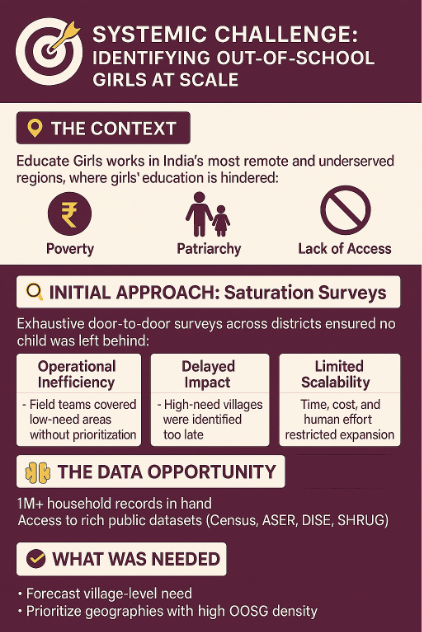
Educate Girls’ saturation-based model ensured full coverage but, as the program scaled, it struggled with efficiency. Field teams spent equal effort across all areas, leading to delayed impact, strained resources, and limited scalability, highlighting the need for a more targeted, data-driven approach.
Development of a machine learning model that used public and survey data to predict village-level need. This enabled the team to prioritize high-need areas, streamline field operations, and shift from blanket outreach to precision targeting, improving scalability without compromising equity.
Educate Girls’ saturation-based approach to identifying out-of-school girls ensured full coverage but lacked efficiency and scalability. Field teams spent equal effort in both high- and low-need areas, delaying impact and straining resources.
With a wealth of household and public data available, the challenge was to shift from blanket coverage to data-driven precision targeting without compromising on equity.
Educate Girls partnered with IDinsight to develop a Machine Learning model using the Random Forest algorithm, trained on survey data from 29 districts and enriched with multiple public datasets (Census, DISE, ASER, SECC, SHRUG). The model was designed to:
- Predict village-level concentrations of OOSGs
- Categorize villages into Plans A–D based on need and operational feasibility
- Identify geographic “hotspots” using clustering
- Prioritize interventions using a ranked list of high-need areas
The shift from Strategy 1.0 (saturation) to Strategy 2.0 (data-driven targeting) marked a fundamental evolution in how Educate Girls approached its mission of turning large datasets into actionable, predictive insights.
Solution Roll-Out Approach
Educate Girls approached the implementation of its machine learning solution with a clear focus on precision, usability, and scalability. Recognizing the complexity of deploying advanced analytics in rural contexts, the organization adopted a phased strategy that blended cutting-edge technology with field-based validation. At every stage, stakeholder feedback, user testing, and real-world learning shaped the platform’s evolution ensuring the model not only predicted need but was actionable on the ground.
- Phase 1: Initial model development using historical household data and public datasets, tested against known field results.
- Phase 2: Model iterations and validations with live field data to refine accuracy. Prediction accuracy reached 90% over three testing cycles.
- Phase 3: Operational integration with strategic planning. Expansion teams used ranked village lists to deploy interventions.
- Phase 4: Model outputs were simplified for non-technical staff and feedback loops were institutionalized. The model was retrained periodically as new data became available.
The transition was supported by a strong emphasis on user interpretation, ensuring that teams could trust and act on ML insights without needing deep technical knowledge.
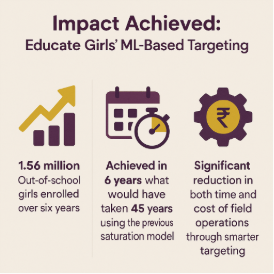
Educate Girls’ adoption of machine learning transformed how outreach was prioritized and scaled, unlocking exponential gains in efficiency and reach.
- 1.56 million out-of-school girls enrolled over 6 years
- Achieved in 6 years what would have taken 45 years under the previous model
- Significant reduction in time and cost for field operation.
Technology Stack
| Tools/ Techniques | Used For | What It Enabled | Category |
|---|---|---|---|
| Python | Development of machine learning model | Flexible and scalable model building for predictive analysis | Open Source |
| Random Forest Algorithm | Predicting village-level concentration of out-of-school girls | High-accuracy (90%) targeting and prioritization of interventions | Open Source |
| Census, DISE, ASER, SECC Datasets | Training data for the model | Data-driven insights using large-scale public datasets | Open Data |
| Custom Dashboard Outputs | Visualization of model predictions for field teams | Easy interpretation and actionable insights for non-technical users | Proprietary |
Key Project Learnings
Educate Girls’ machine learning journey offers practical insights on applying data science in grassroots settings.
Strategic village targeting can exponentially accelerate program reach and cost-efficiency.
Every model iteration must be grounded in actual field data to ensure reliability.
Simplifying outputs enabled frontline and expansion teams to use ML insights effectively.
Potential for Wider Adoption
| Sector | How the Solution Can Be Applied |
| Education | Target regions with low enrollment or high dropout rates using predictive analytics |
| Health | Forecast maternal health risks, malnutrition zones, or immunization gaps |
| Livelihoods | Identify under-skilled populations for targeted vocational training and employment programs |