
Khan Academy
AI tutor delivers personalised, interactive learning support, improving student understanding and teacher productivity at scale.




Watch the story in 60 seconds (AI-generated video; visuals are illustrative)
Case at a Glance
Khan Academy is a nonprofit organisation that aims to provide a free, world-class education to anyone, anywhere. Its proven learning platform offers high-quality, standards-aligned supplemental resources, including instructional videos, practice questions, quizzes, and articles covering preschool to early college academic subjects. The platform is designed to enable mastery learning, allowing students to work at their own pace to bridge learning gaps, fully master concepts, and confidently progress to more advanced topics. Through this vision, it aims to serve underserved students, enabling self-paced learning in multiple Indian languages, and deliver learning to millions of students.
Government classrooms in India struggle to deliver personalised learning due to high student-teacher ratios, diverse learning levels, and limited teacher capacity. While digital tools improved access to content, they have not addressed the need for real-time, tailored instruction to support individual student learning journeys.
Khan Academy India introduced Khanmigo, an AI-powered educational co-pilot integrated into its platform. It provides students with 24/7 personalised tutoring through Socratic interactions and supports teachers with lesson planning, insights, and content generation, among other use cases, to enable scalable, high-quality instruction in resource-constrained classrooms.
India's government school system is a large enterprise that serves over 200 million students under challenging environments, and it is not designed to deliver personalised learning at scale. Classrooms are characterised by high student-teacher ratios, wide variations in learning levels within a single grade, and limited access to specialised STEM educators, particularly in rural and semi-urban areas. Learning gaps have been further exacerbated by the COVID-19-induced school closures for all students in the country.
As a result, teaching tends to default to a one-pace, one-level model, even as student needs vary dramatically. A single Grade 6 classroom may include learners still building foundational arithmetic alongside those ready for pre-algebra. Teachers, however capable, are left with little room to differentiate instruction in real time - not for lack of intent, but for lack of tools and bandwidth.
In practice, this means most students get very little opportunity to work through problems on their own with meaningful support. A teacher managing 40–60 students cannot sit with each one, ask the right guiding question at the right moment, or walk them through a concept step by step when they're stuck. Instruction defaults to one-pace delivery; practice, when it happens, tends to be rote and unsupported. Students either get the answer or they don't, with little in between.
This matters because real understanding is built not just through explanation, but through the process of thinking through problems: making attempts, getting stuck, receiving a nudge in the right direction, and arriving at the answer through one's own reasoning. This kind of Socratic, step-by-step interaction is what turns passive exposure into genuine learning. But it requires a level of one-on-one engagement that is structurally unavailable in most government school classrooms.
Digital learning platforms have expanded access to quality content, but most still operate on a passive model — students watch, read, or select answers, with limited opportunity for the kind of active, guided practice that builds conceptual understanding. Access to content, without the scaffolding of interactive problem-solving, has not translated into the learning gains that underserved students need most.
The core gap, then, is not content — it is the absence of supported, and personalised practice at scale.
Khan Academy India addresses this challenge through Khanmigo — an AI-powered learning co-pilot embedded within its mastery-based platform. Rather than building yet another content delivery tool, Khanmigo is designed to tackle the personalisation gap directly: delivering adaptive, one-on-one learning support in environments where such support has historically been unavailable. It is currently available in over 30 languages, including Hindi, Odia, and Marathi.
At its core, Khanmigo serves two distinct but complementary roles — an always-available tutor for students and a real-time assistant for teachers.
For students, Khanmigo acts as a patient, always-available tutor. It guides learners step by step using questions and hints rather than direct answers, helping students identify and correct mistakes on their own. This approach supports a deeper understanding instead of rote learning. Khanmigo is able to engage even when student questions are incomplete or contain spelling errors, including in Hindi and English, the languages used in Indian pilots.
For teachers, Khanmigo functions as a classroom assistant and productivity tool. It offers ready-to-use prompts for common tasks such as lesson planning, generating quizzes, creating lesson hooks, summarising topics, and reviewing class progress. These tools require minimal input and little training, reducing cognitive load and making adoption easier. Usage data shows that teachers frequently use tools like Class Snapshot, Refresh My Knowledge, Multiple Choice Quiz, and Lesson Hook. Teachers have reported that these tools save them time that they redirect towards teaching and engaging with students directly.
Trust and safety are central to Khanmigo’s design. Student interactions are linked to classroom accounts, allowing teacher oversight. Inappropriate content triggers alerts, the system remains grounded in an age-appropriate curriculum, and student data is not used to train AI models. In surveys, 80% of teachers report that Khanmigo is safe to use in classroom settings.
Khanmigo demonstrates how AI can scale personalised support in education while keeping teachers central to the learning process. By integrating into existing platforms and prioritising safety, usability, and human oversight, it offers a model for responsible AI adoption in schools.
Khanmigo has rapidly evolved from pilot deployments to large-scale implementation across multiple states, demonstrating both high adoption and meaningful classroom integration.
Technology Stack
The User Interface: This is the chat window where students and teachers actually interact with Khanmigo. While it looks like a simple messaging app, it is highly customised for education. It can instantly format complex math equations, draw structured educational diagrams, and even understand voice inputs so students can speak their questions naturally.
The AI Engine: The core "thinking" is powered by a suite of commercial language models — primarily from OpenAI's GPT-4o family, with newer models like GPT-4.1 and Google Gemini being tested for specific use cases. An internal routing service dynamically selects the right model based on the task: a lightweight model for simple admin queries, a more powerful one for complex tutoring, and specialised models for content moderation. This isn't a single AI — it's an orchestrated ensemble, guided by instructional design principles to behave as a Socratic tutor. Rather than providing direct answers, the system is designed to reason step-by-step and guide the student toward finding the solution themselves.
The Moderation Layer: Because Khanmigo operates in schools, safety is the top priority. Before the AI even processes a message, the text passes through a multi-layered security checkpoint. It uses specialised tools to scan for offensive language, bullying, self-harm, or inappropriate topics in real time. If the system detects a policy violation, it blocks the message and triggers the appropriate notification workflow — alerting teachers or district administrators as needed.
Backend Services: Behind the scenes, a network of background systems manages the massive flow of information. Think of these as the school's administrative office. They verify who is logging in, securely route messages to the AI brain, and gather context — like what specific lesson the student is currently looking at — so the AI can provide relevant help.
Streaming Technology: To maintain conversational flow, Khanmigo streams responses token-by-token — essentially word-by-word. This creates the feel of a real-time dialogue rather than a static request-and-response exchange, keeping students engaged throughout the interaction.
Memory and Insight: To provide personalised tutoring, Khanmigo has a secure memory system. It retains past interactions and creates summaries of student progress, allowing the AI to draw on prior session context to tailor its responses. This means a student's difficulties in one session can inform the tutoring approach in the next.
Key Project Learnings
Reaffirmed that AI drives adoption when positioned as a teacher co-pilot, not a replacement
Teachers see benefit in saving time and effort in planning activities that can now be spent with students
Deep integration with learning platforms is critical for effective personalisation
Students need support while being introduced to such tools and developing skills of effective prompting
Localisation (language + voice) improves access and engagement
Designing these products with safety guardrails is imperative to securing buy-in of administrators
Potential for Wider Adoption
| Sector | Adaptability of the Solution |
| K–12 Government Education Systems | It can be scaled across state and national school systems to deliver personalised, adaptive learning at low per-student cost, particularly where high student-teacher ratios make individualised instruction otherwise unviable |
| Foundational Learning & Remedial Programs | Deploys in large-scale "catch-up" initiatives, pinpointing learners' precise gaps and supporting learners with personalised tutoring |
| Teacher Training & Professional Development | Functions as an always-available professional assistant: helping educators strengthen subject knowledge, prepare for classroom scenarios on demand and implement innovation in classroom learning |
| Vocational Training & Skilling | Can enable on-demand, self-paced instruction in skill-based programs, adapting difficulty and pacing to each learner's proficiency level through content and personalised tutoring on our platform |
| Adult Literacy & Continuing Education | Supports adult learners through simple interfaces that lower the literacy barrier in learning digitally, and enable flexible, non-classroom-based learning pathways |
Contributed By: Ojas Arora (KAI), Akash Burlawar (KAI) and Mehak Jain (ILSS)
See it in Action

Explore Khanmigo as a supportive study companion, asking questions, receiving guided explanations, and building understanding while solving maths and science problems, without shortcuts, and with encouragement to think independently
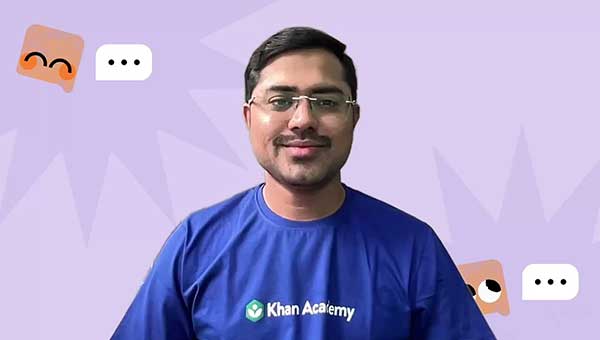
See how Khanmigo supports learning as a trusted companion, guiding students through videos and practice questions with prompts, hints, and encouragement, helping them build understanding, confidence, and independent problem-solving skills without relying on direct answers.

Discover how Subhrajeet uses Khanmigo to solve doubts, strengthen critical thinking, and explore multiple subjects, while building confidence to pursue his aspiration of becoming an artificial intelligence scientist.

Discover how Anju uses Khanmigo to access instant insights, personalise assignments, and track student progress through features like “Test my knowledge” and class snapshots, enhancing teaching effectiveness and student engagement in the classroom.