

AI for Nonprofits & Social Purpose Organisations: Where Should Organisations Start?
In conversations about utilising AI for Nonprofits & social purpose organisations the first question from programme teams is rarely, “Which tool should we use?” More often, it’s simply: “Where do we even start?” For nonprofit leaders, adopting AI doesn’t have to begin with a technology decision. It can begin with an organisational one: what are we trying to do better?
A useful answer may be closer to the everyday work than the technology itself. Start by mapping your workflows, identifying where teams are spending time, and understanding the problems worth solving. Then ask where AI can help and which tools can support it.
Start with the work, not the word "AI"
Many organisations get stuck because they ask, “What can AI do for us?” before mapping what actually takes up their teams’ time. Is it a program manager manually cleaning survey responses every month? The finance team re-entering the same donor data across multiple spreadsheets? Or field teams adapting the same report for different funders?
These challenges may not need an “AI strategy” to begin with. A useful first step is simply to spot the repetition, understand where time is being lost, and see where AI can take some of that work off the team’s hands.
Where AI genuinely helps nonprofits & social purpose organisations right now
The opportunity for AI may be much broader, but for resource-constrained SPOs (social purpose organisations), a good place to start is often with smaller, practical problems that show up in everyday work.
Georgetown University's AI Toolkit for Nonprofits identifies four broad areas where AI can create value: operational efficiency, service delivery, advocacy and decision-making1.
Operational efficiency and service delivery are often the most practical starting points, because they connect directly to everyday work. Advocacy and decision-making may require stronger data foundations, organisational alignment, and supporting infrastructure before AI can deliver meaningful value.

Cleaning and structuring data: AI can help standardise years of inconsistent beneficiary data, identify anomalies, and reduce time spent on manual cleaning.
Drafting reports: AI can create first drafts from structured data, giving program teams something to refine rather than starting from scratch.
Summarising long documents: Grant guidelines, policy updates, or research papers can be condensed into key points, making information quicker to navigate and use.
Handling repetitive queries: AI-powered chatbots can respond to routine questions using existing FAQs and program information, while staff step in where human judgement is needed.
In Practice: Start with One Engagement Problem
NudgED Trust offers a useful example - its “Top Parent” platform supports early learning for low-income families, but keeping parents engaged between learning activities was a practical challenge.
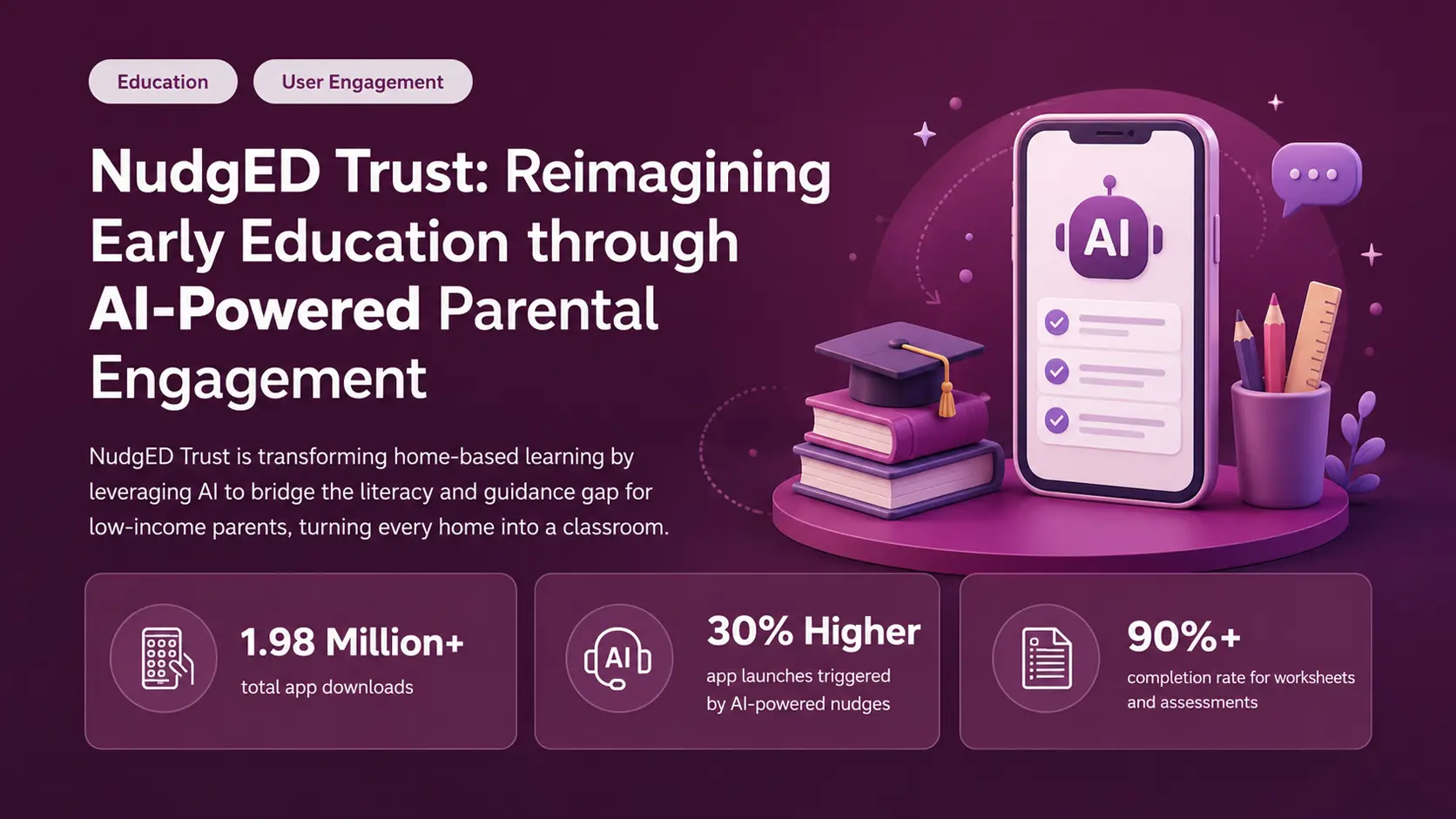
The organisation introduced personalised AI-powered nudges through WhatsApp, using user activity data to determine when and what to prompt. It also added voice-based and conversational AI in Hindi and Marathi to make the platform easier to use for parents with limited literacy.
The platform has crossed 1.98 million downloads, with AI-powered nudges driving 30% higher app launches, and a completion rate of 90%+ on worksheets and assessments.2
The lesson for nonprofits and social purpose organisations: Start with the problem, not the scale of the AI ambition. Identify one clear challenge, determine where AI can help, and define what success looks like.
In this case, NudgED started with a specific engagement problem and clear metrics. It also surfaces the next question every organisation should ask themselves: Are our underlying systems ready to support the AI use case we have in mind?
The constraint nobody wants to talk about
AI cannot compensate for missing data, broken processes, or unclear ownership.
Readiness is about more than simply having your data. GivingTuesday’s 2024 AI Readiness Survey found gaps among smaller Indian nonprofits in areas such as data-use policies and cloud data storage3. Larger organisations were more likely to have MERL (Monitoring, Evaluation, Research, and Learning) and technology personnel, but less likely to use data-sharing agreements.
There is also a question of responsibility: Who can access the data? How can it be used? And when should a person review an AI-generated output? Is the data ultimately compliant with the DPDP act? For nonprofits and social purpose organisations handling beneficiary information, these considerations need to be built into the workflow from the start.
Before exploring an AI use case, look at the foundations beneath it: Is the data reliable? Is the process clear? Is there ownership and oversight? The quality of what AI produces will depend heavily on the systems supporting it.
Learning about AI without getting lost in it
Teams new to AI can easily spend a lot of time trying to understand the technology before putting it to use. But there is only so much that terminology and theory can teach you without applying it to real work.
A program manager does not need to understand how a language model is trained to assess whether it can help draft a report. Try it on a real task, compare the output with what you would normally produce, and learn from there.
The goal is not to know everything about AI before you begin. It is to know enough to start testing it thoughtfully.
Run one small pilot
For a first experiment, keep the scope narrow. Choose one well-defined task and give someone clear ownership of it.
Pick one repetitive, reviewable task
Report drafting, data cleaning, or FAQ handling are good starting points because the output is easy to check against a human-written version.Assign one person to own the pilot
Diffuse ownership is a common reason early AI pilots stall after the initial enthusiasm fades.Set a time limit
Usually four to six weeks, and measure something concrete: hours saved, error rate, turnaround time.Decide before starting what "working" looks like
Without this, pilots tend to continue indefinitely without ever being formally adopted or dropped.
After the pilot, the organisation should have a clearer sense of whether the tool is worth trying elsewhere.
Where this leaves Nonprofits & Social purpose organisations
AI doesn’t need to sit apart from program work as a separate initiative competing for budget and attention. Its value becomes clearer when it is connected to the work teams are already trying to improve.
If a team can clearly identify the task or challenge AI is meant to support, that is a good place to begin. Start with the work. Find the friction. Test where AI can help. Then measure whether it actually did.
Frequently Asked Questions
With a single repetitive, reviewable task, not a strategy document. Pick something a staff member already does every week (report drafting, data cleaning, answering the same donor questions) and test one tool against it for four to six weeks. AI for nonprofits & social purpose organisations works best as a series of small, measured pilots, not a sector-wide rollout.Where should nonprofits & Social purpose organisations start with AI?
AI for social impact is the wider field: research, funding, cross-sector initiatives applying AI to social problems. AI for Nonprofits & social purpose organisations is narrower and more operational: what a specific, resource-constrained organisation can actually implement with its existing staff and data. Most nonprofits & Social Purpose organisations need the operational version, not the research agenda.What's the difference between AI for social impact and AI for nonprofits & social purpose organisations?
Not quite. AI for good usually describes the mission or intent behind a project. It doesn't tell an organisation what to build or where to start. An NGO can fully support the idea of AI for good and still have no clear entry point until it identifies a concrete internal workflow to fix.Is "AI for good" the same thing as AI for Nonprofits & social purpose organisations?
Skip general AI information courses built for enterprise audiences. They rarely cover data privacy for beneficiary records or funder reporting formats. For social purpose organisations, ILSS's Learning Series can be a useful starting point. It focuses on practical applications of AI and digital transformation in the social sector, helping teams learn through relevant examples rather than generic theory.Where should NGO staff go to learn about AI without wasting time?
Decide the success measure before starting, not after. Hours saved, error rate compared to the manual process, or turnaround time are all concrete enough to check. If nobody can point to a number after six weeks, the pilot hasn't proven anything either way.How do we know if an AI pilot is actually working?
References
1. Georgetown University, Center for Public and Nonprofit Leadership. AI Toolkit for Nonprofits: Framework View source
2. Digital-transformation-case-studies: NudgED Trust: Reimagining Early Education through AI-Powered Parental Engagement
3. GivingTuesday Generosity AI Working Group. AI Readiness Survey Report 2024: India. View source
The information provided here is created as a community resource and is not intended as professional advice or a recommendation by ILSS or Koita Foundation. While we strive to ensure the accuracy of the content, we do not take responsibility for any errors or omissions. Users should use their own discretion before making any decisions based on this information. ILSS or Koita Foundation assume no liability for any actions taken based on the information provided.