

Nagios

Open-source IT infrastructure monitoring tool for nonprofits and social purpose organisations

Nagios is an open-source monitoring system for tracking the health and performance of servers, networks, and applications. It provides continuous monitoring and alerting for infrastructure components such as servers, switches, databases, and services, helping organisations ensure system reliability and uptime.
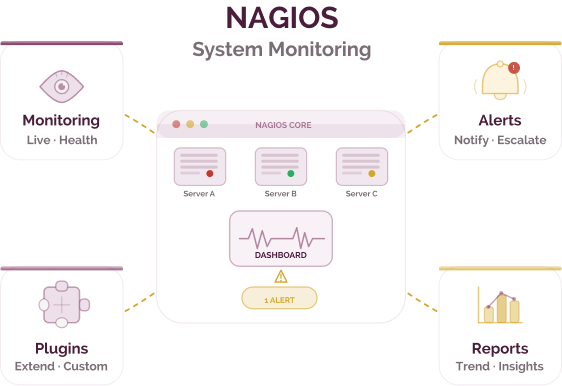
Monitoring critical systems without commercial tool costs

Challenge
check

Limited visibility into system health across programme databases, websites, and internal tools

check

System issues such as downtime or slow performance often detected only after affecting programme delivery or beneficiary access

check

Reliance on manual monitoring by small IT teams, making it difficult to scale across locations

check

Lack of real-time alerts to proactively identify and resolve technical issues

check

Budget constraints make commercial monitoring tools difficult to adopt

Solution
check

Nagios provides continuous, self-hosted monitoring of servers, networks, and applications, with alerts triggered when predefined thresholds are breached. This enables early detection of issues without recurring licence costs.

Key capabilities of Nagios

Infrastructure and service monitoring

Monitor servers, network devices, applications, and services such as HTTP, SMTP, and databases

Alerting and escalation

Configure alerts and escalation workflows via email, SMS, or scripts based on defined thresholds

Plugin-based extensibility

Leverage a large ecosystem of community plugins to monitor a wide range of systems

Performance data and reporting

Track historical performance data to support troubleshooting and capacity planning

Pricing for nonprofits

Nagios Core (open-source)

  • Free — no licence fees or device limits

Nagios XI (commercial)

  • From ~$1,995 (perpetual licence)
  • Includes web interface, reporting, and enterprise features

Nonprofit access

  • No formal nonprofit discount; the open-source version is typically used
  • ⚠ Requires server setup and ongoing technical maintenance

Best suited for which nonprofits?

Organisations with in-house IT capacity

Strong fit — requires Linux and system administration skills

Organisations needing zero-cost monitoring

Strong fit — fully open-source with no licence cost

Organisations managing their own infrastructure

Strong fit — suitable for servers, networks, and hosted systems

Small NGOs without IT support

Not recommended — setup and maintenance complexity is high

Similar tools

Frequently Asked Questions

When should a nonprofit use Nagios?

When it manages servers or infrastructure and needs continuous monitoring without paying for commercial tools

When is Nagios not the right fit?

If the organisation does not have the technical capacity to install and manage a self-hosted system

Is Nagios completely free?

Nagios Core is fully open-source and free to use, with no licence fees. Nagios XI is a commercial version with additional features and paid licensing.

What can Nagios monitor?

Nagios can monitor servers, network devices, applications, databases, and services such as websites and email systems.

Does Nagios store monitoring data externally?

No, Nagios Core is self-hosted, so monitoring data remains within the organisation’s own infrastructure unless configured otherwise.

Want to learn more?

The information provided here is created as a community resource and is not intended as professional advice or a recommendation by ILSS or Koita Foundation. While we strive to ensure the accuracy of the content, we do not take responsibility for any errors or omissions. Users should use their own discretion before making any decisions based on this information. ILSS or Koita Foundation assume no liability for any actions taken based on the information provided.