

Beyond ChatGPT: How Nonprofits Can Use AI Across Programs and Operations
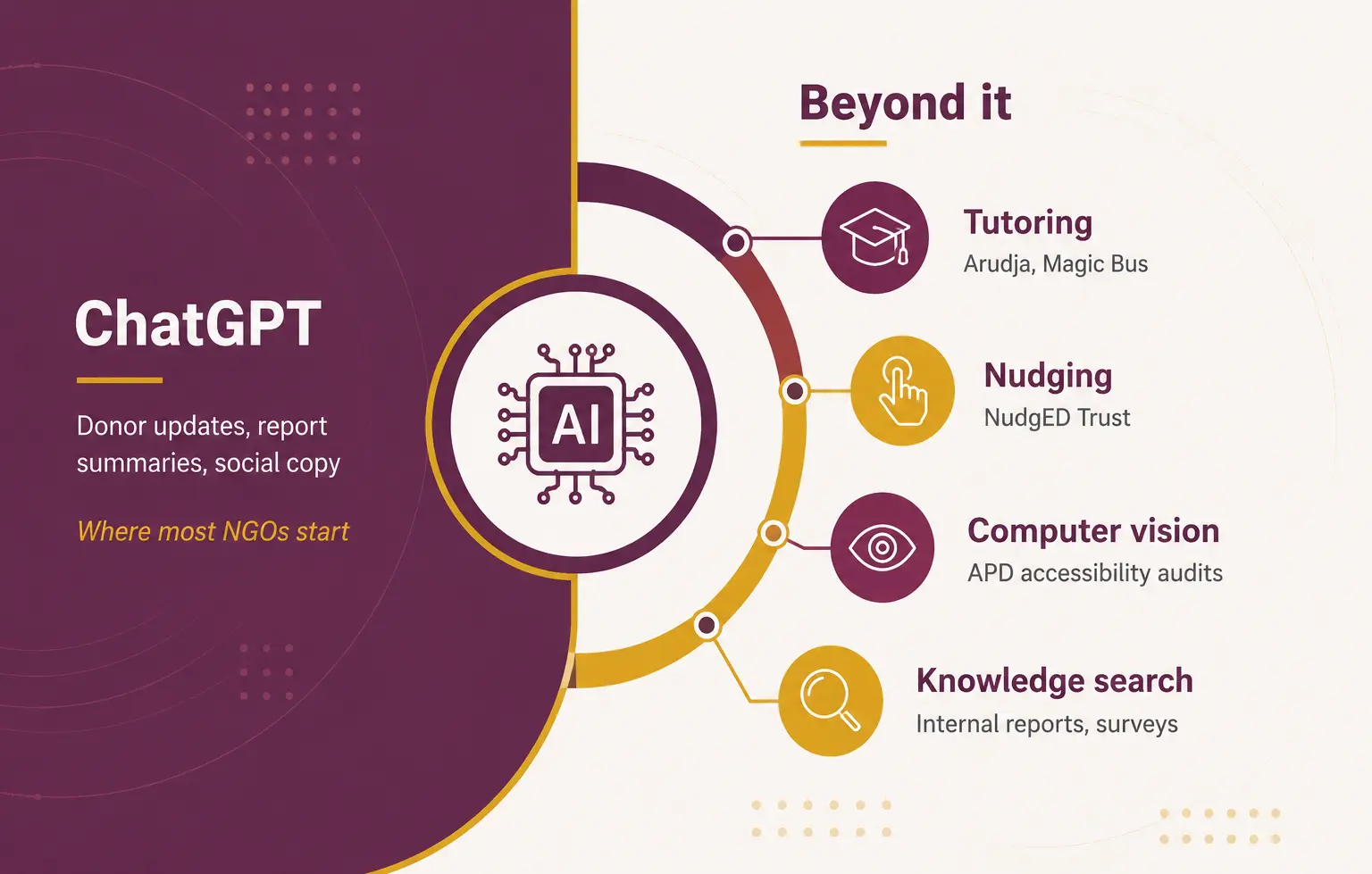
For many Nonprofits, AI starts with ChatGPT. A donor update. A report summary. Social media copy. These are often the first experiments.
But ChatGPT represents only one way AI can be used.
But AI can do more than generate text.
It can help a learner practise independently. It can help an organisation respond differently to people based on their needs or behaviour. It can assist with tasks that would otherwise require more specialist time. And it can help teams find useful information buried across years of reports and documents.
This does not mean every Nonprofits needs to adopt every type of AI.
It means the starting point should not always be the tool.
Before asking, “Which AI tool should we use?”, it can be more useful to ask:
“What is taking too much time, difficult to manage, or hard to do at scale?”
That is where the exploration can begin.
Look at the Work Before Looking at the Tool
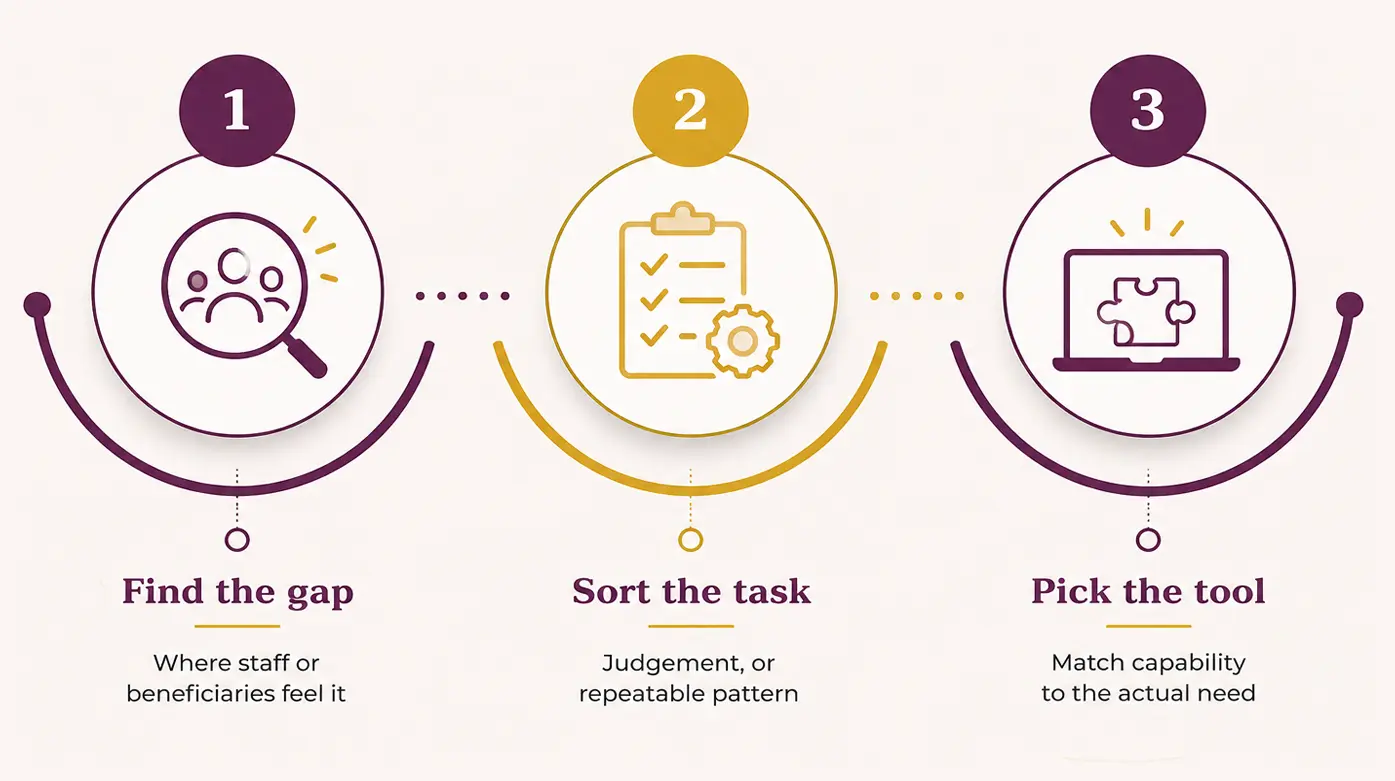
Start by looking for the pressure points.
Where are staff repeating the same task? Where do beneficiaries need more individual attention than the team can provide? What information is being collected but rarely examined?
The DT4SI case studies show how different the answers can be. Anudip and Magic Bus support learners [1][2], NudgED responds to user behaviour [3], and APD uses computer vision for accessibility audits [4].The problem came first. The technology followed.
AI Inside Program Delivery
Personalised support becomes difficult when programs grow.
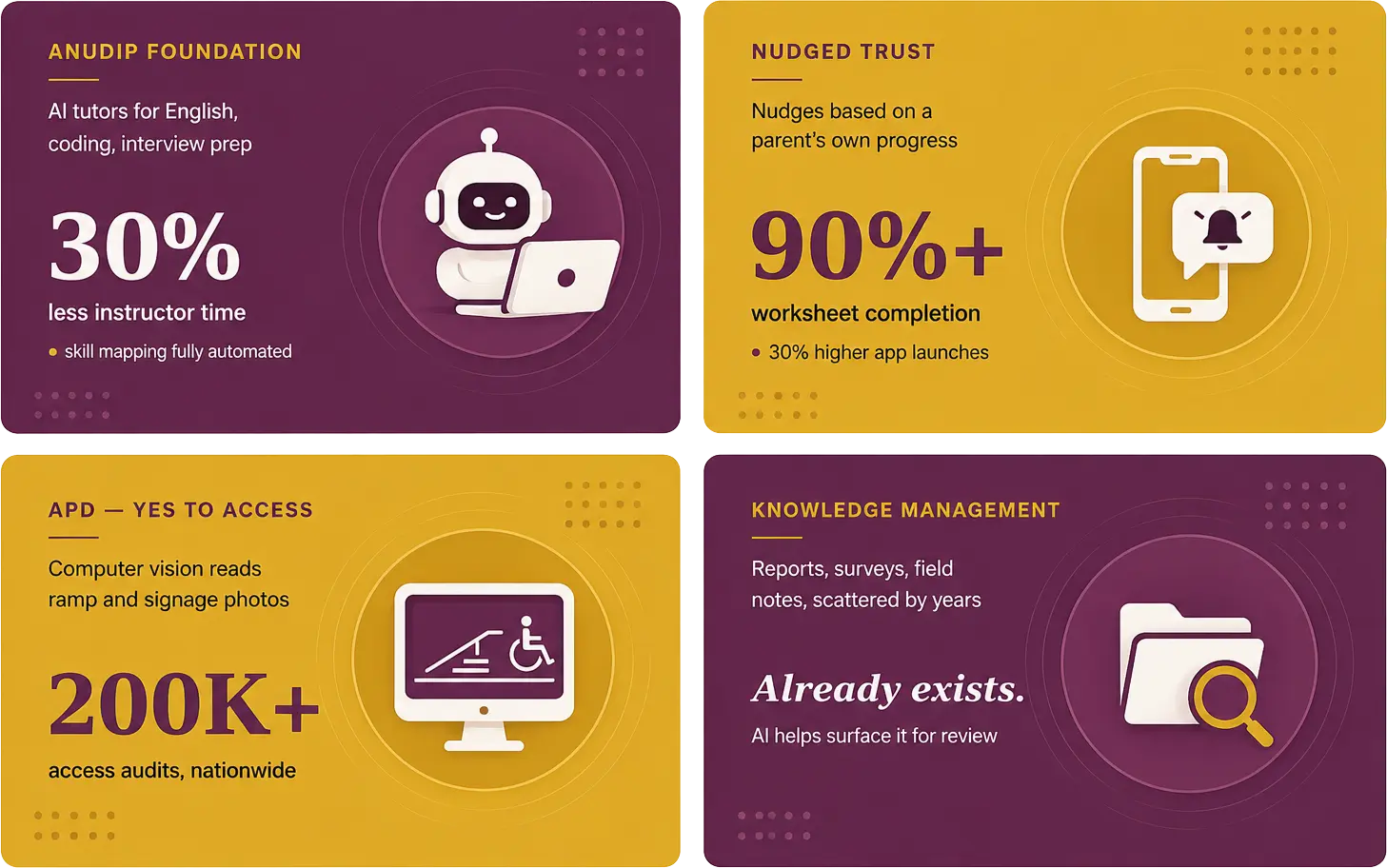
Anudip built AI-enabled tutors and coaches into its learning system for areas including English, coding and interview preparation. The case reported a 30% reduction in instructor time and 100% automation of skill mapping for job nominations [1].
Magic Bus approached the same capacity issue differently. Its voice tutor allows learners to practise English and life skills individually and supports 10–12 Indian languages [2].
But support is not only about giving people answers. It can also mean recognising when someone needs a different kind of interaction.
Making Beneficiary Engagement Respond to Behaviour
Many Nonprofits already use WhatsApp or apps to communicate with beneficiaries. The harder question is deciding what to say, when to say it and to whom.
NudgED Trust's Top Parent platform uses AI to personalise learning pathways and nudges based on a user's progress. Its case study reported 30% higher app launches triggered by AI-powered nudges and over 90% completion of worksheets and assessments [3].
A parent who has completed an activity does not need the same reminder again. Someone who has stopped engaging may need a different interaction.
Organisations exploring this type of use case can look at conversational AI, messaging, voice interfaces and user analytics in the DT4SI digital tools directory [5].
When AI Helps Non-Specialists Do More
Some AI applications have little to do with writing or chatbots.
The Association of People with Disability (APD) faced a problem with accessibility audits. Specialist assessments take time, making it difficult to examine a large number of public spaces.
Its Yes to Access app uses computer vision to analyse photographs of accessibility features such as ramps and signage.
Volunteers collect information from the field, while AI helps turn those observations into structured assessments. The case reports more than 200,000 location audits across India [4].
In the right use cases, AI can help reduce routine bottlenecks, allowing specialists to focus on work that requires deeper judgement.
When the Organisation Knows More Than It Can Use
A program team needs evidence from a project completed three years ago. The report exists somewhere.
So do the beneficiary insights, survey results and lessons from implementation. Finding and bringing that information together can be harder than collecting it in the first place.
Nonprofits often accumulate knowledge through program reports, surveys, beneficiary feedback and internal documents. Over time, this information can become spread across teams, projects and years of work, making it difficult to find and use when needed [6].
This is a longstanding knowledge management challenge in the nonprofit sector [6].
The information may already exist. The challenge is bringing it together.
AI can help staff search across approved documents, identify recurring themes and bring relevant information together for human review. Its value may not be in creating something new, but in helping an organisation use what it already knows.
But the more closely AI is involved in organisational information and beneficiary interactions, the more important the question of oversight becomes.
The Level of Checking Should Match the Use
A tool that helps draft a report does not raise the same concerns as one that analyses beneficiary data or interacts directly with program participants.
NITI Aayog's work on Responsible AI calls for AI systems to be assessed in relation to their context and potential risks [7].
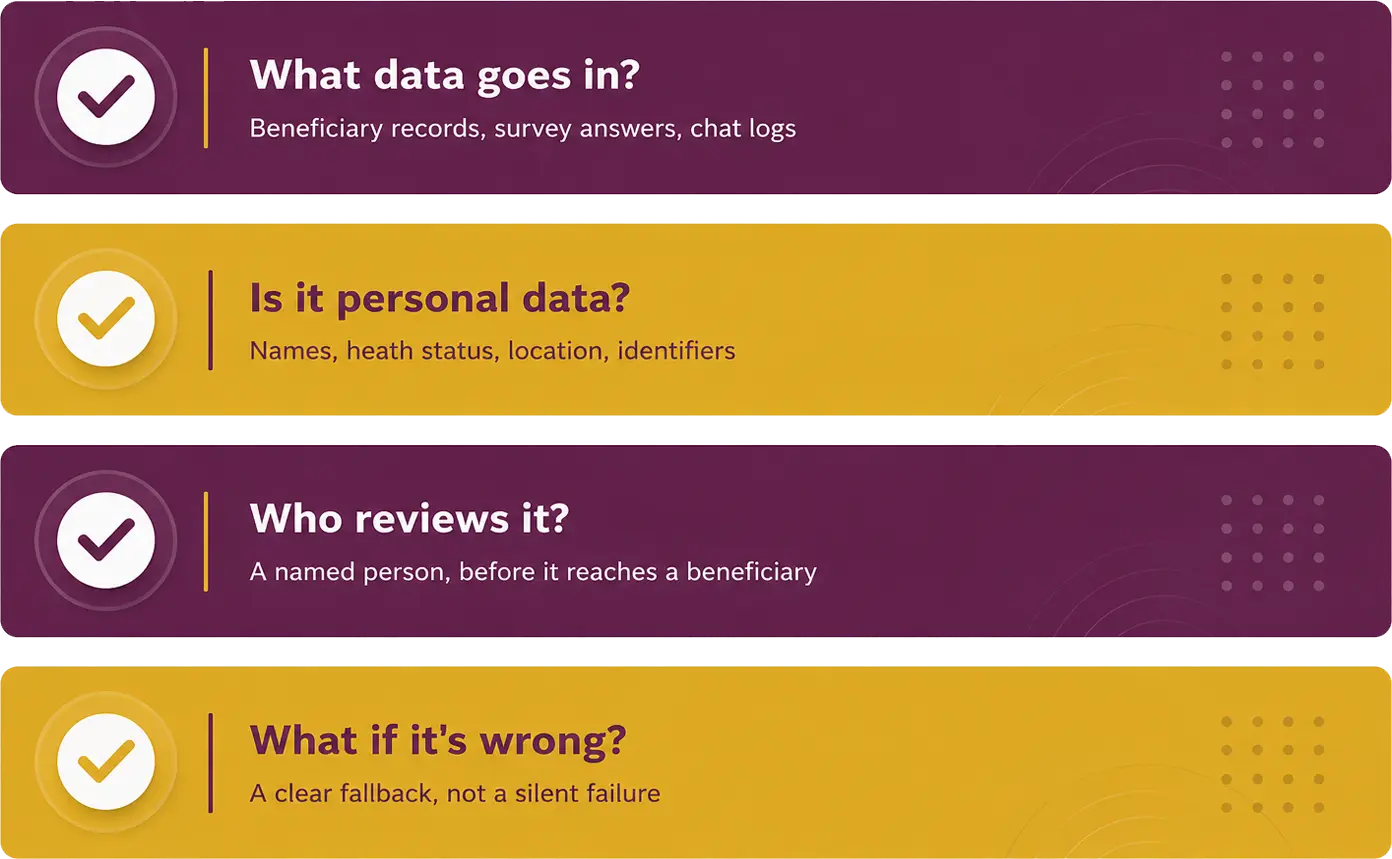
Before putting AI into a workflow, organisations should ask:
Where digital personal data is involved, organisations also need to consider the Digital Personal Data Protection Act, 2023 [8].
The level of review should match the role AI plays in the work.
Start Where the Work Starts Breaking Down
Maybe learners are waiting too long for feedback. Maybe staff spend hours reviewing information that follows a repeatable pattern. Maybe beneficiaries receive the same communication even though their needs and behaviour differ.
Start there and ask what part of that work requires human judgement, what part follows a repeatable pattern, and whether AI is actually suited to assist.
DT4SI's digital tools directory [5] and case studies [1][2][3][4] can then help organisations explore the technology relevant to that particular use case.
Frequently Asked Questions
No. ChatGPT is one type of generative AI tool. The case studies featured here show other uses, including personalised learning, voice-based interaction, behaviour-based engagement and computer vision for accessibility audits.Is ChatGPT the only way Nonprofits can use AI?
Start with a problem in the current way of working. Look for tasks where staff capacity is stretched, beneficiaries need more individual support, large volumes of information are difficult to review, or existing digital interactions could be more responsive.Where should an Nonprofits start with AI?
Not necessarily. Some organisations use existing AI models, APIs or open-source technologies, while others build applications around a specific programme need. The choice depends on what the organisation is trying to do and whether an existing tool can support that work.Do Nonprofits need to build their own AI tools?
Yes, as the cases of Magic Bus and NudgED show. AI can support direct interactions through voice, conversational interfaces and personalised communication. The design of these systems should consider the users, the information being processed and the level of human oversight needed.Can AI be used directly with beneficiaries?
Organisations should understand what information the AI system will receive, whether it includes identifiable personal data, who can access that information, and how outputs will be reviewed before they affect a beneficiary or programme decision. India's data protection framework is also relevant where digital personal data is involved.What should Nonprofits consider before using AI with beneficiary data?
References
1. Anudip Foundation: Bridging the Skills Gap through an Agentic AI Learning Ecosystem — DT4SI Case Study. Read the case study
2. Magic Bus India Foundation: Democratizing Personalized Skilling through Magic AI — DT4SI Case Study. Read the case study
3. NudgED Trust: Reimagining Early Education through AI-Powered Parental Engagement — DT4SI Case Study. Read the case study
4. The Association of People with Disability (APD): AI-Powered Universal Accessibility — DT4SI Case Study. Read the case study
5. DT4SI Digital Tools Directory — Explore digital tools for nonprofits
6. Knowledge Management in Nonprofit Organizations — Academic reference on knowledge management challenges in the nonprofit sector. Read the source
7. NITI Aayog: Responsible AI Resources — Explore the resources
8. Digital Personal Data Protection Act, 2023 — Government of India. Read the Act
The information provided here is created as a community resource and is not intended as professional advice or a recommendation by ILSS or Koita Foundation. While we strive to ensure the accuracy of the content, we do not take responsibility for any errors or omissions. Users should use their own discretion before making any decisions based on this information. ILSS or Koita Foundation assume no liability for any actions taken based on the information provided.