

Meshy AI

AI-powered 3D model generation for NGOs and SPOs.

Meshy AI is an AI-powered platform that enables users to generate and edit 3D models from text or images, supporting visual content creation for communication, learning, and digital use.
Meshy Ai

Creative and design challenges for nonprofits and social purpose organisations

Challenge
check

Creating visual and 3D content typically requires specialised tools, time, and skills.

check

Nonprofits may face limitations in producing clear visual representations of ideas, programmes, or concepts.

check

Communicating complex ideas or interventions visually can be difficult without design resources.

Solution
check

Tools like Meshy AI enable organisations to generate and modify 3D models using AI, helping teams create visual content more easily without specialised design workflows.

Key capabilities of Meshy AI

Core capabilities that support AI-based 3D content creation, especially for teams with limited design resources:

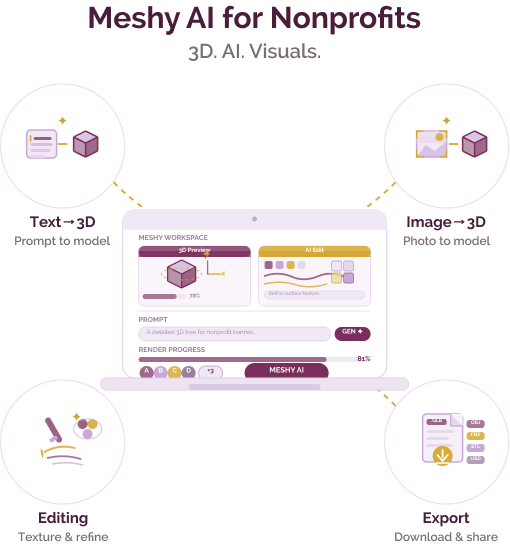
Text to 3D generation.

Create 3D models from text descriptions, helping teams visualise ideas without requiring specialised design skills.

Image to 3D conversion.

Convert images or sketches into 3D models using AI, enabling visual representation of concepts without manual modelling.

AI-based editing and texturing.

Modify and enhance 3D models using text or image inputs, improving visual quality without advanced tools.

Export and compatibility.

Export models in multiple formats for use across presentations, digital platforms, and design workflows.

Pricing for nonprofits

Meshy AI follows a credit-based pricing model with free and paid plans, allowing organisations to scale 3D content creation based on their needs and available resources.

Free plan.

  • Includes limited monthly credits for generating 3D models.
  • Suitable for testing and initial exploration.
  • Helps teams assess usefulness before committing resources.

Paid plans.

  • Provide higher monthly credits and additional features.
  • Suitable for organisations with regular content or communication needs.
  • Support more consistent and scalable content creation.

Enterprise or team plans.

  • Designed for organisations with larger teams or higher usage needs.
  • Include collaboration features and higher generation capacity.
  • Custom pricing may be available.

Best suited for which nonprofits

Meshy AI is best suited for organisations that need visual and 3D content to support communication, learning, and idea representation.


Teams exploring AI-based visual tools.

Useful for experimenting with AI-generated 3D content for communication or training.

Programmes requiring concept visualisation.

Helps represent ideas, interventions, or programme concepts visually.

Organisations with limited design resources.

Reduces dependency on specialised 3D design skills.

Teams creating interactive or visual prototypes.

Useful for generating 3D assets for demos, presentations, or digital experiences.

Similar tools for creative and design

Frequently Asked Questions

What is Meshy AI used for?

It is used to generate and edit 3D models using AI for visual content creation.

Is it suitable for nonprofits?

It can be useful for organisations that need visual content for communication, learning, or digital use.

Which teams is this useful for?

It can be used by teams creating digital content, including communication, programme, and design teams.

Does it require technical expertise?

It reduces the need for specialised 3D design skills, though some familiarity may be helpful.

Are there nonprofit-specific examples of use?

Specific nonprofit case studies may be limited, but similar tools can support communication and visual needs.

Want to learn more?

The information provided here is created as a community resource and is not intended as professional advice or a recommendation by ILSS or Koita Foundation. While we strive to ensure the accuracy of the content, we do not take responsibility for any errors or omissions. Users should use their own discretion before making any decisions based on this information. ILSS or Koita Foundation assume no liability for any actions taken based on the information provided.