

Google BigQuery

Cloud data warehouse for large-scale data storage and analysis

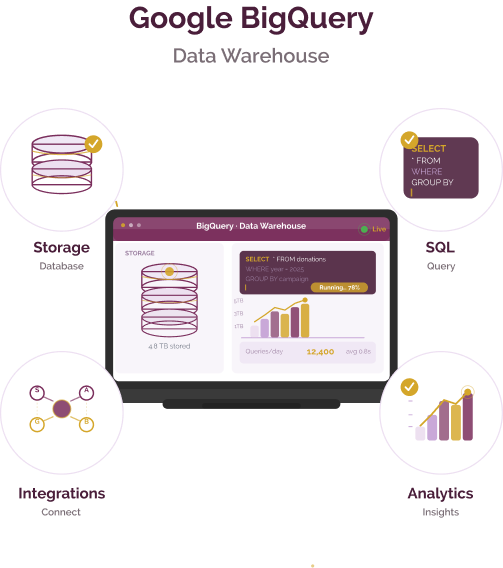
Google Cloud BigQuery is a serverless cloud data warehouse that enables organisations to store and analyse large datasets using SQL. It allows users to run complex queries, store and manage vast amounts of data, and integrate with various data analytics and business intelligence tools.
Google BigQuery

Data management and analysis challenges for nonprofits and social purpose organisations

Challenge
check

Programme, beneficiary, financial, and survey data are spread across multiple systems, making it difficult to build a unified view.

check

As data grows across locations and time periods, spreadsheets become slow, error-prone, and difficult to manage.

check

Teams spend significant time combining data from different sources for donor reporting and monitoring and evaluation (M&E).

Solution
check

Google BigQuery enables organisations to centralise data from multiple systems and analyse it efficiently using SQL.

Key capabilities

Scalable data storage and querying

Analyse large datasets efficiently without performance limitations typical of spreadsheets.

Integration with multiple data sources

Combine data from CRMs, survey tools, financial systems, and analytics platforms.

SQL-based analysis

Explore and analyse structured data using standard SQL.

Serverless infrastructure

No infrastructure management required; scaling is handled automatically.

Pricing for Nonprofits

Free tier

  • Limited free usage for storage and queries

Paid usage

  • Based on data storage and query processing

Additional cost considerations

  • Costs can increase with large datasets and frequent queries

Best suited for which nonprofits?

Big Query is designed for specific organisational contexts - check if yours is a match.

Large NGOs managing data across multiple programmes or locations

Organisations conducting monitoring, evaluation, or research

Teams already using multiple digital systems (CRM, surveys, finance tools)

Frequently Asked Questions

When should a nonprofit use Tableau?

Tableau is most useful when organisations already have structured data and need to analyse it, build dashboards, and communicate insights for reporting and decision-making.

Does Tableau help with data collection?

No. Tableau does not collect data. It connects to existing data sources such as spreadsheets, databases, and MIS systems to analyse and visualise data.

What kind of data works best with Tableau?

Tableau works best with structured datasets such as programme data, beneficiary records, financial data, and survey results that are already organised for analysis.

Is Tableau suitable for small or early-stage organisations?

It may not be necessary for organisations with small datasets or simple reporting needs. Lighter tools may be more appropriate in early stages.

Does Tableau require technical skills?

Basic dashboards can be created using its drag-and-drop interface, but effective use requires understanding of data structure, analysis, and dashboard design.

Want to learn more?

The information provided here is created as a community resource and is not intended as professional advice or a recommendation by ILSS or Koita Foundation. While we strive to ensure the accuracy of the content, we do not take responsibility for any errors or omissions. Users should use their own discretion before making any decisions based on this information. ILSS or Koita Foundation assume no liability for any actions taken based on the information provided.