


M-Files

Document management system for organising and controlling organisational information in nonprofits and social purpose organisations

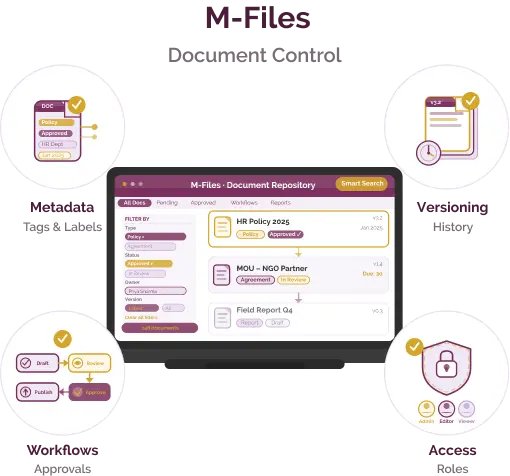
M-Files is a document management system that enables organisations to organise, manage, and control documents and information. It uses a metadata-based approach, allowing documents to be classified and retrieved based on attributes such as project, donor, or document type rather than folder structures.

Managing documents, compliance, and version control across programmes

Challenge
check

Nonprofits manage large volumes of documents such as reports, grant agreements, policies, and donor communications across shared drives or folders

check

Files may be duplicated, mislabelled, or difficult to retrieve

check

Version control becomes unclear when multiple team members edit documents

check

Compliance-related documents are not always consistently tracked

Solution
check

M-Files enables organisations to organise documents using metadata, supporting structured storage, version control, and controlled access to information.

Key capabilities of M-Files

Metadata-based organisation

Organise documents based on attributes (e.g., project, donor, type) instead of folder structures

Version control and audit trails

Track document changes, maintain version history, and monitor access

Workflow automation

Automate document approval processes and lifecycle stages

Access control and permissions

Define user roles and restrict access to sensitive documents

M-Files in action

Grant and donor documentation

Grant and donor documentation

Store agreements, reports, and supporting documents with structured access

Read Full Case Study
Policy and compliance management

Policy and compliance management

Maintain controlled versions of organisational policies and records

Read Full Case Study
Programme documentation

Programme documentation

Organise reports, field data, and internal documents across teams

Read Full Case Study
Audit and reporting support

Audit and reporting support

Track document history and maintain records for audit processes

Read Full Case Study

Pricing for nonprofits

Subscription-based pricing

Pricing is not publicly standardised and varies based on users, storage, and deployment

Deployment options

Cloud-based or on-premise

Nonprofit access

No publicly listed nonprofit pricing; organisations typically request quotes

Best suited for which nonprofits?

Organisations managing high document volumes

Useful for handling structured records across programmes and functions

Organisations with compliance or audit requirements

Supports version control, audit trails, and document governance

Medium to large nonprofits

More relevant where document complexity and control requirements are higher

Small organisations with simple needs

May be more complex than required

Similar tools

Microsoft SharePoint
Google Drive

Frequently Asked Questions

When should a nonprofit use M-Files?

When document volume, version control, and compliance requirements become difficult to manage through shared drives.

When is M-Files not the right fit?

If document management needs are simple and can be handled through basic cloud storage tools.

What does M-Files focus on?

It focuses on structured document management, including metadata, version control, and workflow-based processes.

Does it require technical setup?

Implementation and configuration typically require planning and technical support.

Can it support audits and compliance?

It includes features such as version history, access logs, and workflows that can support audit and compliance processes.

The information provided here is created as a community resource and is not intended as professional advice or a recommendation by ILSS or Koita Foundation. While we strive to ensure the accuracy of the content, we do not take responsibility for any errors or omissions. Users should use their own discretion before making any decisions based on this information. ILSS or Koita Foundation assume no liability for any actions taken based on the information provided.
