
I-Saksham: Scaling Grassroot Leadership with Purpose Built AI
How I-Saksham leveraged AI-assisted tools like Gemini 1.5 and a custom MIS to streamline peer coaching, enabling faster feedback and scalable, human-centered mentoring.


Watch the story in 60 seconds (AI-generated video; visuals are illustrative)
Case at a Glance
I-Saksham is a grassroots nonprofit working to empower young women from marginalized communities as edu-leaders, equipping them to deliver quality education and transform their communities through a two-year fellowship program.
I-Saksham faced significant bottlenecks in its peer coaching "Buddy Talk" process, essential for edu-leader development. Manual, time-intensive feedback led to delays (20-30 days), low buddy-to-fellow ratios (1:8), inconsistent coaching quality, and unstructured data, hindering efficient scaling of their human-centered mentoring model.
I-Saksham implemented an AI-assisted mentoring solution to streamline the "Buddy Talk" process. This involved leveraging technology to automate and accelerate feedback, reducing operational burden while maintaining a human-centered approach. The solution was rolled out using a phased, user-driven strategy, engaging field teams as co-designers to ensure effective adoption.
Every edu leader is assigned a coach known as a buddy and the peer coaching conversations are key to the development of the edu leader. Building capacity of buddies to conduct effective coaching is also critical as they are recent graduates from the fellowship.
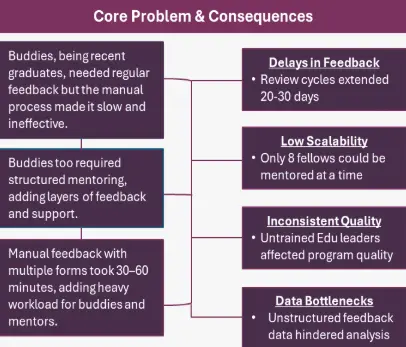
As the fellowship scaled, I-Saksham faced a key bottleneck in its Buddy Talk process-the peer coaching conversations between edu-leaders and their assigned buddies. Since buddies were recent graduates, they too needed structured support, creating a dual mentoring requirement.
The manual, two-step feedback process was time intensive. Buddies submitted detailed forms after each session, which were reviewed by mentors who added their own feedback. Each cycle took 30 to 60 minutes, placing a heavy documentation burden on both roles.
This led to delayed feedback (20–30 days), low buddy-to-fellow ratios (1:8), inconsistent coaching quality, and unstructured data that was difficult to analyze. i-Saksham needed a solution that would reduce this operational load without compromising its human-centered mentoring model.
This led to a roll out of a user-led tech solution that streamlined peer coaching by enhancing human processes through co-design and iterative pilots.
The solution rollout followed a phased, user-driven approach. Starting with pilot cohorts, the tech was tested, adapted, and integrated into existing workflows. Field teams were treated as co-designers, not end users fostering trust and ensuring adoption.
A lean, 7-member tech/data team supported implementation, and monthly review cycles maintained strategic alignment. The focus wasn’t on replacing human processes but making them faster, lighter, and more consistent.
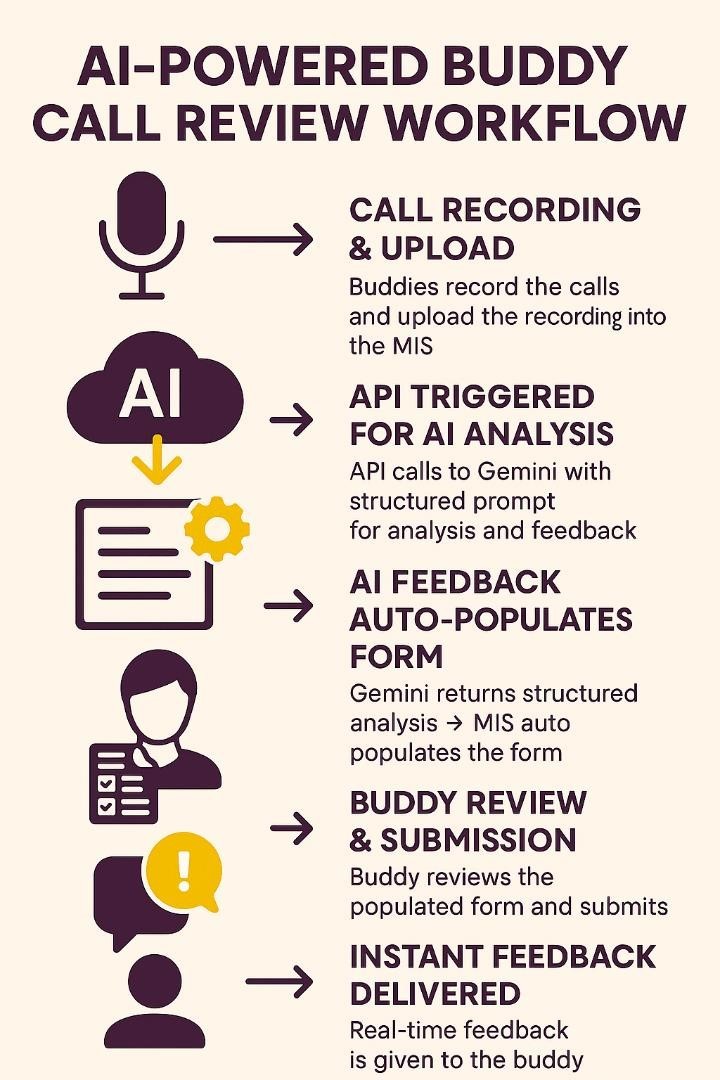
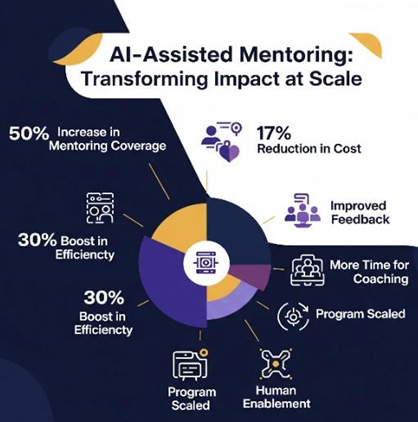
The shift to AI-assisted mentoring produced outsized results:
- 50% increase in mentoring coverage (8 → 12–16 fellows per buddy)
- 17% reduction in per-fellow mentoring cost
- 30% boost in buddy efficiency
- Significant improvement in feedback quality and timeliness
- Staff time freed for coaching and strategic focus
- Program scaled without compromising its core values
- Not just digital transformation but human enablement at scale.
Technology Stack
| Tools/Techniques | Used For | What It Enabled | Category |
|---|---|---|---|
| Google Workspace | Early MIS setup, documentation, and internal coordination | Organized data management and seamless team collaboration in early stages | Commercial |
| Gemini | Custom-built solution for AI-based transcription and feedback summarization of mentoring sessions, using Gemini 1.5 | Faster, structured, and higher-quality feedback; reduced manual effort and turnaround time | Commercial |
| Microsoft Azure | Cloud infrastructure to support applications and data storage | Scalable, reliable backend infrastructure for AI and MIS systems | Commercial |
| Amazon Web Services | Cloud infrastructure to support applications and data storage | Scalable, reliable backend infrastructure for AI and MIS systems | Commercial |
| Custom MIS + WhatsApp Bot | Custom implementation for reporting, workflow integration, and user interaction | Real-time data capture, improved adoption among field users, and streamlined workflows | Proprietary |
| Zoom | Remote mentoring sessions and communication | Enabled virtual coaching, expanding reach and continuity of mentoring | Commercial |
Key Project Learnings
User-centric design is crucial for tech adoption and building trust.
AI acts as a co-pilot, enhancing human work, not replacing it.
Small, contextual innovations can drive significant systemic change.
Potential for Wider Adoption
| NGOs running mentoring or fellowship programs (e.g., TFI, Piramal Foundation) |
| Healthcare nonprofits supervising field workers |
| CSR programs tracking trainers or volunteers |
| Rural incubators offering coaching/mentoring |
| Any org using call-based support or peer feedback loops |