
Udhyam Learning Foundation: Udhyam Saathi – AI Mentor
Strengthening Entrepreneurial Mindsets at Scale through AI-Enabled Mentorship


Watch the story in 60 seconds (AI-generated video; visuals are illustrative)
Case at a Glance
Udhyam Learning Foundation envisions a caring world where people fearlessly pursue their potential. It addresses India’s opportunity crisis by building agency and entrepreneurial mindsets at scale through a four-year Entrepreneurial Mindset Curriculum (EMC), implemented with state governments for students and teachers in Grades 9–12 across government schools.
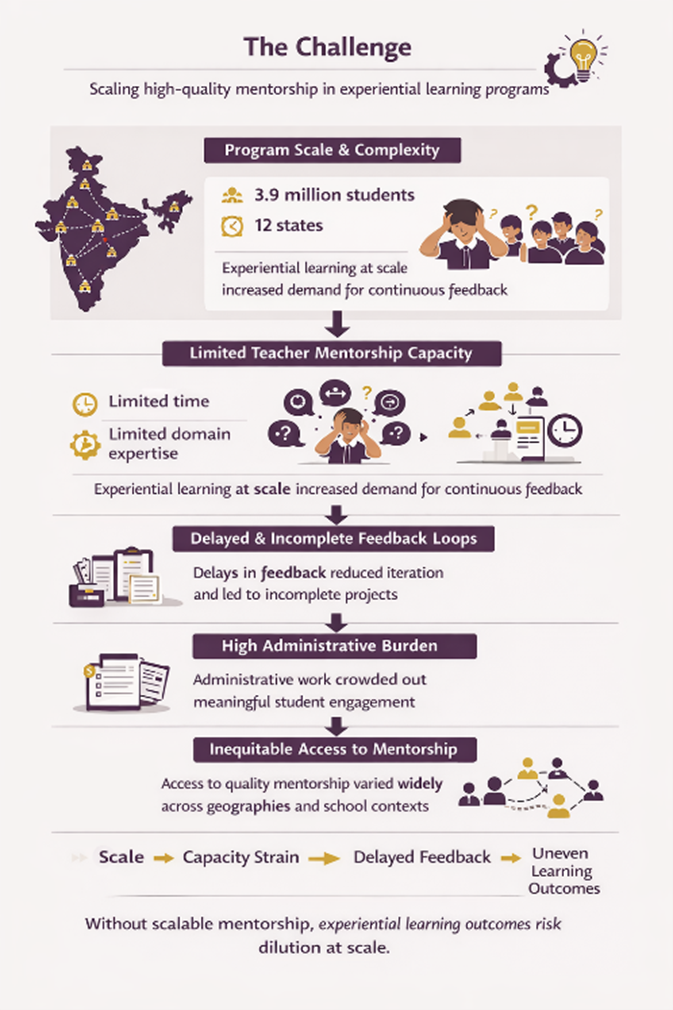
Udhyam’s Entrepreneurial Mindset Curriculum reaches millions of students across diverse contexts. At scale, however, teachers face a mentorship bottleneck and are unable to provide timely, personalised, and domain-specific feedback on student projects. This results in incomplete work, limited iteration, and uneven learning outcomes, constraining the effectiveness of experiential, project-based learning.
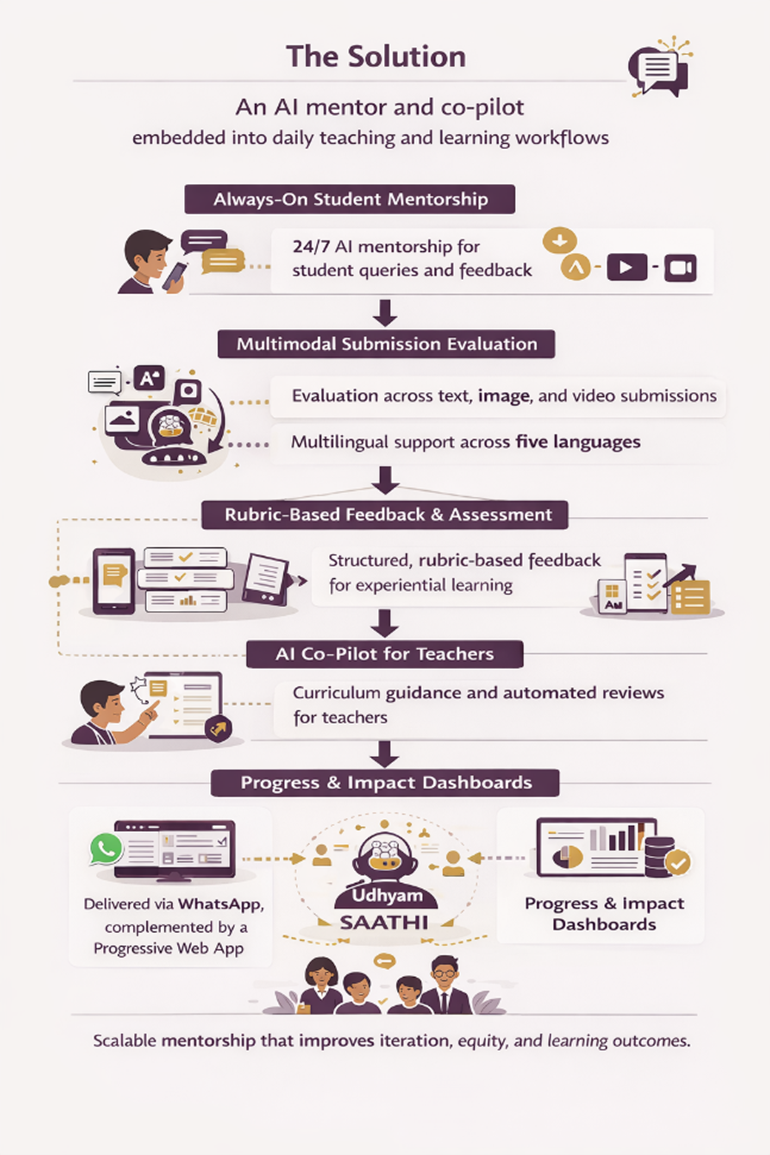
Udhyam Saathi is an AI-powered mentor designed to deliver equitable, continuous support to students and teachers at scale. For students, it functions as a 24/7 mentor answering project queries in multiple languages, evaluating ideas, prototypes, and pitches, and providing personalised, rubric-based feedback that supports iterative learning. For teachers, it serves as an AI co-pilot, automating reviews, resolving curriculum queries, and tracking student progress to enable more focused, high-quality coaching.
Udhyam’s Entrepreneurial Mindset Curriculum emphasises learning by doing, requiring regular feedback on ideas, prototypes, and projects. As the program scaled to 3.9 million students across 12 states, teachers faced increasing demands on time and expertise.
Key challenges included:
Udhyam Saathi was designed as a multilingual, multimodal AI mentor delivered primarily through WhatsApp, complemented by a Progressive Web App for additional support. The solution enables continuous student–mentor interaction while integrating seamlessly into existing program structures.
Key features of the solution include:
- 24/7 AI mentorship for students, including query resolution and personalised feedback
- Evaluation of submissions across text, image, and video formats
- Multilingual support across five languages
- Rubric-based assessment and feedback for ideas, prototypes, and pitches
- AI co-pilot support for teachers, including curriculum guidance and automated reviews
- Dashboards for tracking student progress and program impact
To ensure safe, reliable, and scalable use, Udhyam embedded strong implementation and governance safeguards within the solution:
Rollout approach: Implemented with state governments through formal MoUs, localised for context, supported by trained teachers/local teams, and tracked via dashboards, observations, and surveys.
Guardrails & validation: Queries are pre-processed (relevance/intent checks); irrelevant queries are declined, and unclear ones are guided with options. Rubric-based evaluation and periodic checks help maintain data quality and reliability; prompt guardrails include a Negative Test Suite for handling out-of-scope cases.
Privacy & access control: Student PII is not shown on dashboards and is not exposed to LLMs; data is masked by default, and access is authorisation-based (approval + NDA where needed). APIs/data transfers are SSL-secured, and the pipeline is designed to be self-contained.
Quality & risk monitoring: Performance is monitored through CSAT and observability tooling (Langfuse), along with regular audits/feedback loops to reduce bias and improve response reliability at scale.
Technology Stack
| Tools/ Techniques | Used For | What It Enabled | Category |
|---|---|---|---|
| Glific | Student and teacher interactions on the WhatsApp platform | Conversational AI delivery at scale | Commercial |
| Progressive Web App (PWA) | Extended user support | Rich interaction beyond chat | Custom-built |
| RAG Knowledge System | Content retrieval | Context-aware responses using vector embedding | Custom-built |
| MongoDB (Vector Embeddings) | Knowledge base | Retrieval and logging of learning data | Open Source |
| Google Cloud Platform | API-driven backend services using Python | Scalable AI service deployment | Commercial |
| Google Big Query | Primary data store | Analytics and impact measurement | Commercial |
| Langfuse (RAGAS Evaluation) | Observability | Quality monitoring and evaluation | Open Source |
| Google Looker Studio | Dashboards | Visualisation and data analysis | Commercial |
Key Project Learnings
Udhyam’s deployment illustrates how AI-enabled mentorship can strengthen experiential learning outcomes at scale:
Introducing AI-based mentoring addressed teacher capacity constraints and ensured students received timely, personalised feedback. This led to higher participation in milestone submissions and more consistent progression through the curriculum.
Delivering mentorship through familiar platforms such as WhatsApp reduced friction for students and teachers. This ease of access enabled sustained usage and rapid scaling across states.
Rubric-based, timely feedback encouraged students to revise and improve their work. This directly contributed to higher curriculum adherence, increased resubmissions, and measurable improvements in overall project quality.
Potential for Wider Adaptation
| Sector | Adaptability of the Solution |
| State Education Systems | Scalable support for experiential and project-based learning programs |
| Skilling and Employability Programs | Continuous mentorship for youth-led projects and skill development |
| Teacher Capacity Building | AI co-pilots to improve instructional and mentoring capacity |
See it in Action
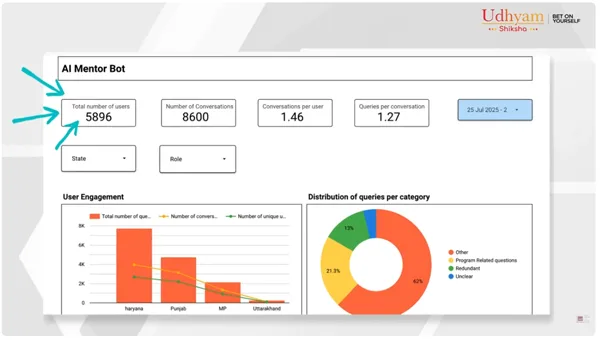
Udhyam’s AI mentor delivers entrepreneurial learning via WhatsApp, offering multilingual guidance, onboarding, nudges, and personalized feedback at scale for students and teachers.

A lecturer from Patiala shares how the AI Mentor chatbot has been a standout digital assistant — quick, responsive, and effective at clearing doubts for both teachers and students.

A teacher reflects on using the AI Mentor chatbot to support students through their projects — describing how it helps with registration, addresses common challenges, and keeps students motivated and on track